





High-Power Lithium-Ion Capacitors (LIC)
Bridging high-energy lithium batteries and high-power supercapacitors with extreme power throughput, sub-5ms pulse response, and maintenance-free design lifetimes up to 20 years.
Peak Power Density
Max Instantaneous Pulse
Operating Temperature
Deep Cycle Lifetime
Why Lithium-Ion Capacitors
Li-ion capacitors merge the energy density of a battery with the power density, ultra-long life, and wide temperature range of a supercapacitor.
| Metric | LIC ★ (our product) | Li-ion Battery (LIB) | EDLC Supercapacitor |
|---|---|---|---|
| Energy density | Med-high · ≈58 Wh/kg | High · 200+ Wh/kg | Very low · ≤10 Wh/kg |
| Power density | Very high · ≈12 kW/kg | Med-low · ≤2 kW/kg | Very high · 10+ kW/kg |
| Cycle life | Ultra-long · ≥20k @0.5C | Short · 2,000–5,000 cycles | Extremely long · 100k+ cycles |
| Cell voltage | 3.8–4.0 V | 3.6–4.2 V | ≤ 2.7 V |
| Low-temp. performance | Excellent · ≥60% @ -25°C / 20C | Notable decay | Good |
| Safety | Inherently safe ★ | Thermal management needed | Inherently safe |
| Instantaneous current (200C) | Supported · 25 A | Not supported | Supported |
| Sub-5 ms response | Supported ★ | Not supported | Supported |
| Positioning: Dozens of times faster than a battery, storing several times the energy of a capacitor — engineered for applications requiring instant burst power, deep cycle life, and high operating safety simultaneously. | |||
Demanding Application Fields
Mission-critical industrial and compute environments engineered for sub-second pulse power and high-frequency cycling.

Robotics & Embodied AI
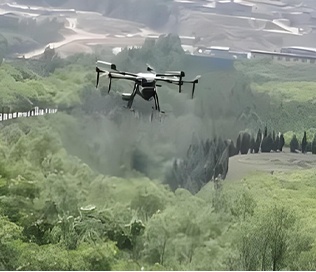
Joint servo start/stop demands current pulses far above average power. LICs respond in milliseconds for instant energy replenishment and sustain tens of thousands of cycles under high-frequency action.
4.0V high-power · HLIC1230V4R0307-P
AI Data Center
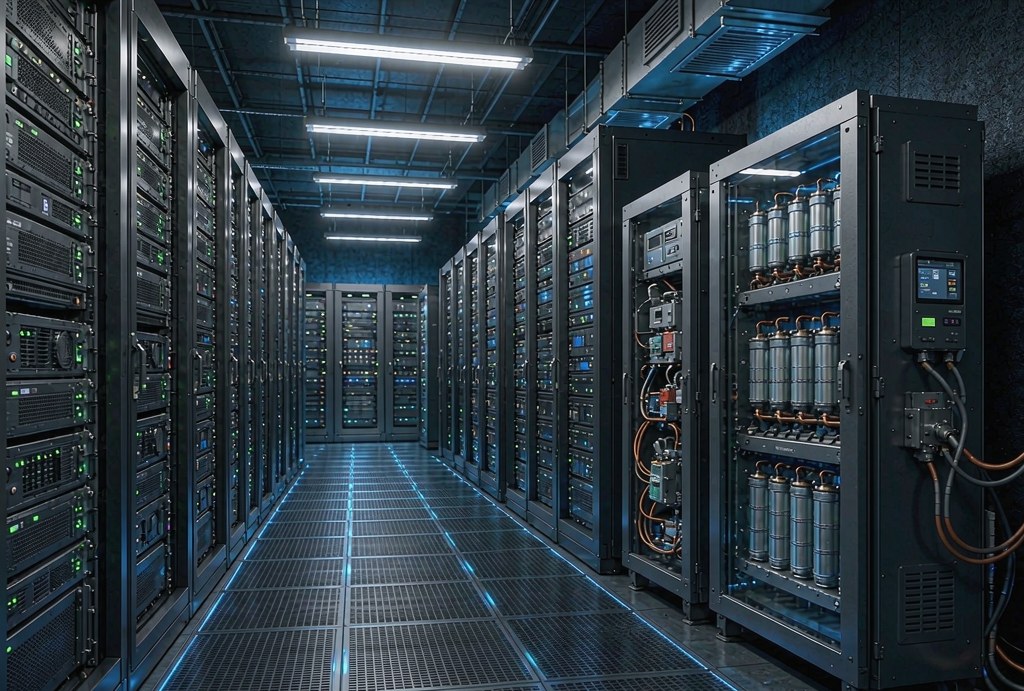
Rising compute density drives transient power spikes. The 4.0V high-power type performs millisecond peak shaving and power-loss protection on the bus, cutting backup response from seconds to milliseconds.
4.0V high-power · HLIC1865V4R0188-P
Chip Black-Start & Backup
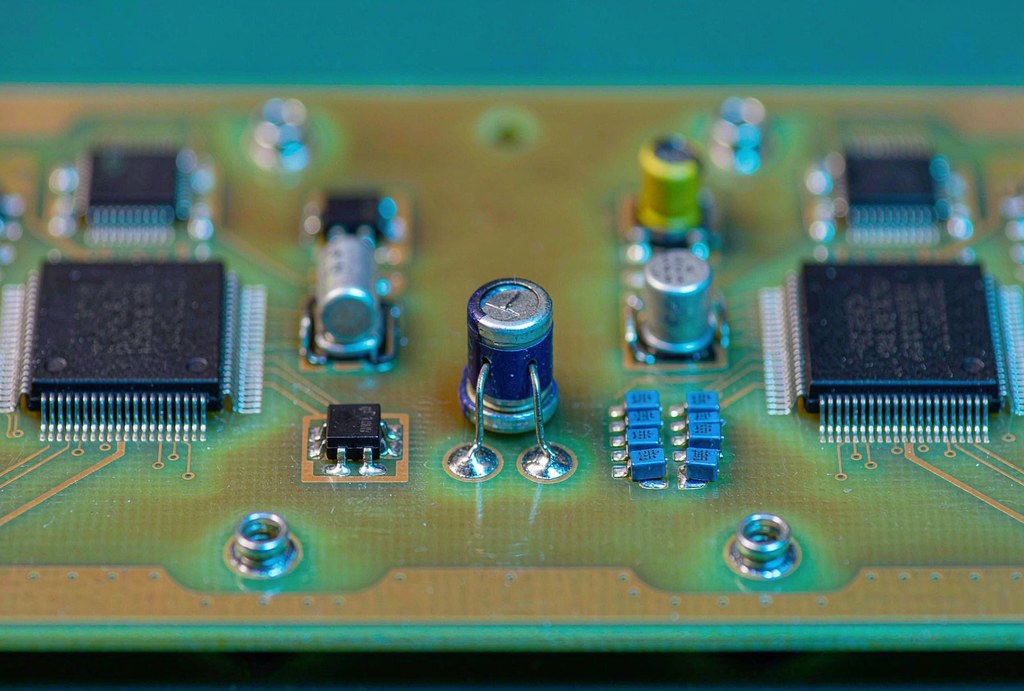
After power loss, key control chips must complete data write-back and state saving. LICs meet the brief high-current demand at power-down with low ESR and fast response.
4.0V / 2.7V series
Six Core Characteristics
Bridging the energy density of batteries with the instantaneous power density and wide-temperature endurance of supercapacitors.
01
Millisecond High Current
< 5 ms response; peak power governed by ESR (Pmax = V² / 4·ESR).
02
Ultra-High Power Density
≈ 12 kW/kg power density, 200C instantaneous discharge capability.
03
Ultra-Long Cycle Life
≥ 20,000 cycles @ 0.5C; ≥ 5,000 cycles at high rate; ≥ 90% capacity after 2-year static storage at 3.6V.
04
Wide-Temperature Operation
Stable discharge down to -45 °C on the 2.7V family, supported by empirical laboratory test curves.
05
Intrinsically Safe Structure
Passes UL 810A abuse tests (nail, crush, short circuit); certified UN38.3 and RoHS compliant.
06
Maintenance-Free Long Life
Design lifetimes up to 20 years, replacing lead-acid batteries and bulky EDLC supercapacitor banks.
Voltage Platforms & Cell Specifications
Select from 4.0V high-power cells, 3.6V high-energy cells, and 2.7V wide-temperature arctic cells. Detailed dimensions, internal resistance (ESR), peak pulse currents, and part numbering guidelines are tabulated below.
4.0V Series · High Power & Rapid Pulse
5 F – 5000 F | 4.0 – 2.5 V (Surge 4.2V) | -30 °C ~ +70 °C | 20,000 Cycles | Up to 100 Wh/kg
| Cap. (F) | Part Number | ESR (Ω) | Energy (mWh) | Pmax (W) | Pulse (A) | Cont. (A) | LC (μA) | D (mm) | Dmax | Lmax | P (mm) | d (mm) | Wt (g) |
|---|---|---|---|---|---|---|---|---|---|---|---|---|---|
| 5 | HLIC0412V4R0056-R | 1.600 | 6.77 | 2.5 | 0.63 | 0.04 | 20 | 4.0 | 4.5 | 13.0 | 1.5 | 0.45 | 0.35 |
| 10 | HLIC6312V4R0106-R | 0.800 | 13.5 | 5 | 1.25 | 0.08 | 20 | 6.3 | 6.8 | 13.0 | 2.6 | 0.50 | 0.65 |
| 20 | HLIC0812V4R0206-R | 0.400 | 27.1 | 10 | 1.25 | 0.16 | 22 | 8.0 | 8.5 | 13.0 | 3.5 | 0.60 | 1.2 |
| 30 | HLIC0816V4R0306-R | 0.250 | 40.6 | 16 | 1.25 | 0.24 | 24 | 8.0 | 8.5 | 17.0 | 3.5 | 0.60 | 1.85 |
| 40 | HLIC0820V4R0406-R | 0.200 | 54.2 | 20 | 5 | 0.32 | 25 | 8.0 | 8.5 | 21.0 | 3.5 | 0.60 | 2.2 |
| 50 | HLIC0825V4R0506-R | 0.180 | 67.7 | 22.2 | 8.33 | 0.4 | 27 | 8.0 | 8.5 | 26.0 | 3.5 | 0.60 | 2.5 |
| 30 | HLIC1016V4R0306-R | 0.200 | 40.6 | 20 | 1.25 | 0.24 | 24 | 10.0 | 10.5 | 17.0 | 5.3 | 0.60 | 1.8 |
| 80 | HLIC1020V4R0806-R | 0.150 | 108.3 | 26.7 | 8.33 | 0.64 | 28 | 10.0 | 10.5 | 21.0 | 5.3 | 0.60 | 3.6 |
| 100 | HLIC1025V4R0107-R | 0.120 | 135.4 | 33.3 | 8.33 | 0.8 | 30 | 10.0 | 10.5 | 26.0 | 5.3 | 0.60 | 4.2 |
| 120 | HLIC1220V4R0127-R | 0.100 | 162.5 | 40 | 8.33 | 1 | 32 | 12.5 | 13.0 | 21.0 | 5.3 | 0.60 | 4.8 |
| 180 | HLIC1225V4R0187-R | 0.075 | 243.7 | 53.3 | 8.33 | 1.5 | 36 | 12.5 | 13.0 | 26.0 | 5.3 | 0.60 | 6.2 |
| 220 | HLIC1230V4R0227-R | 0.050 | 297.9 | 80 | 20 | 1.8 | 40 | 12.5 | 13.0 | 31.0 | 5.3 | 0.60 | 6.5 |
| 300 | HLIC1230V4R0307-P ★ | 0.035 | 406 | 90 | 25 | 3.75 | 58 | 12.5 | 13.0 | 31.0 | 5.3 | 0.60 | 7.1 |
| 300 | HLIC1625V4R0307-R | 0.045 | 406.2 | 88.9 | 25 | 1.8 | 40 | 16.0 | 16.5 | 26.0 | 7.8 | 0.80 | 11.5 |
| 380 | HLIC1630V4R0387-R | 0.040 | 514.6 | 100 | 25 | 2.25 | 40 | 16.0 | 16.5 | 31.0 | 7.8 | 0.80 | 13.5 |
| 750 | HLIC1840V4R0757-R | 0.025 | 1015.6 | 160 | 25 | 4.5 | 50 | 18.5 | 19.0 | 41.0 | 7.8 | 0.80 | 21 |
| 1000 | HLIC1845V4R0108-E | 0.020 | 1354.2 | 200 | 50 | 6 | 55 | 18.5 | 19.0 | 46.0 | 7.8 | 0.80 | 25 |
| 1300 | HLIC1850V4R0138-P | 0.016 | 1787.5 | 202.5 | 50 | 11 | 58 | 18.5 | 19.0 | 51.0 | 7.8 | 0.80 | 28.5 |
| 1800 | HLIC1865V4R0188-P | 0.012 | 2437.5 | 270 | 50 | 15 | 61 | 18.5 | 19.0 | 66.0 | 7.8 | 0.80 | 40 |
| 5000 | HLIC2468V4R0508-E | 0.010 | 6770.8 | 400 | 100 | 20 | 100 | 24.0 | 24.5 | 69.0 | 10.0 | 1.00 | 65 |
| 20000 | HLIC40135V4R0209-P ★ | 0.0012 | 26000 | 4000 | 800 | 8.0 | 100 | 40.0 | 40.2 | 136.0 | — | — | 330 |
Test Conditions & Definitions: ESR tested per IEC 62391-1 (+20°C, test current mA = 8·C·V) · Stored Energy E(mWh) = ½·C·(V₁²−V₂²)·1000/3600 · Peak Power P(W) = V²/(4·ESR) · Pulse current: discharge from rated voltage to ½V within 1 s · Continuous current at 15°C temperature rise · Cycle life: rated voltage ↔ ½V, +20°C, 3 s rest.
3.6V Series · High Volumetric Energy Density
390 F – 2000 F | 3.6 – 2.5 V (Surge 3.75V) | -20 °C ~ +80 °C | 50,000 Cycles | Up to 65 Wh/kg
| Cap. (F) | Part Number | ESR (Ω) | Energy (mWh) | Pmax (W) | Pulse (A) | Cont. (A) | LC (μA) | D (mm) | Dmax | Lmax | P (mm) | d (mm) | Wt (g) |
|---|---|---|---|---|---|---|---|---|---|---|---|---|---|
| 390 | HLIC1030V3R6397-E | 0.060 | 363.5 | 54 | 6 | 2.4 | 65 | 10.0 | 10.5 | 31.0 | 5.3 | 0.60 | 5.3 |
| 1500 | HLIC1850V3R6158-E | 0.020 | 1398 | 162 | 17.6 | 6.6 | 50 | 18.5 | 19.0 | 51.0 | 7.8 | 0.80 | 28.5 |
| 2000 | HLIC1865V3R6208-E | 0.015 | 1864 | 216 | 23.2 | 8.7 | 45 | 18.5 | 19.0 | 66.0 | 7.8 | 0.80 | 40 |
Test Conditions & Definitions: ESR tested per IEC 62391-1 (+20°C, test current mA = 8·C·V) · Stored Energy E(mWh) = ½·C·(V₁²−V₂²)·1000/3600 · Peak Power P(W) = V²/(4·ESR) · Pulse current: discharge from rated voltage to ½V within 1 s · Continuous current at 15°C temperature rise · Cycle life: rated voltage ↔ ½V, +20°C, 3 s rest.
2.7V Series · Wide-Temperature & Arctic High Energy
10 F – 5000 F | 2.7 – 1.8 V (Surge 2.8V) | -45 °C ~ +80 °C | 20,000–50,000 Cycles | Up to 89 Wh/kg
| Cap. (F) | Part Number | ESR (Ω) | Energy (mWh) | Pmax (W) | Pulse (A) | Cont. (A) | LC (μA) | D (mm) | Dmax | Lmax | P (mm) | d (mm) | Wt (g) |
|---|---|---|---|---|---|---|---|---|---|---|---|---|---|
| 8 | HLIC0412V2R7086-R | 1.600 | 7.05 | 1.2 | 0.15 | 0.06 | 20.1 | 4.0 | 4.5 | 13.0 | 1.5 | 0.45 | 0.35 |
| 16 | HLIC0420V2R7166-R | 0.800 | 14.1 | 2.3 | 0.3 | 0.12 | 23.5 | 4.0 | 4.5 | 21.0 | 1.5 | 0.45 | 0.6 |
| 12 | HLIC6307V2R7126-E | 0.800 | 11.75 | 2.3 | 0.25 | 0.1 | 23.5 | 6.3 | 6.8 | 8.0 | 2.6 | 0.50 | 0.5 |
| 500 | HLIC1045V2R7507-E | 0.080 | 517.0 | 22.8 | 10 | 4 | 76.0 | 10.0 | 10.5 | 46.0 | 5.3 | 0.60 | 6.8 |
| 500 | HLIC1235V2R7507-E | 0.070 | 470.0 | 26.1 | 10 | 4 | 67.1 | 12.5 | 13.0 | 36.0 | 5.3 | 0.60 | 7 |
| 750 | HLIC1335V2R7757-E | 0.050 | 705.0 | 36.48 | 15 | 6 | 70.5 | 13.0 | 13.5 | 36.0 | 5.3 | 0.80 | 10 |
| 1200 | HLIC1450V2R7128-E | 0.040 | 1175.0 | 45.6 | 25 | 7.5 | 71.2 | 14.0 | 14.5 | 51.0 | 5.3 | 0.80 | 16.5 |
| 2000 | HLIC1850V2R7208-E | 0.015 | 2100.0 | 121.6 | 34 | 17 | 70.5 | 18.5 | 19.0 | 51.0 | 7.8 | 0.80 | 29.8 |
| 3000 | HLIC1865V2R7308-E | 0.012 | 3000.0 | 152.0 | 50 | 18.75 | 75.0 | 18.5 | 19.0 | 66.0 | 7.8 | 0.80 | 39.5 |
| 5000 | HLIC2468V2R7508-E | 0.010 | 5800.0 | 182.4 | 60 | 24 | 89.0 | 24.0 | 24.5 | 69.0 | 10.0 | 1.00 | 65 |
Test Conditions & Definitions: ESR tested per IEC 62391-1 (+20°C, test current mA = 8·C·V) · Stored Energy E(mWh) = ½·C·(V₁²−V₂²)·1000/3600 · Peak Power P(W) = V²/(4·ESR) · Pulse current: discharge from rated voltage to ½V within 1 s · Continuous current at 15°C temperature rise · Cycle life: rated voltage ↔ ½V, +20°C, 3 s rest.
Measured Performance Curves & Test Reports
Empirical laboratory test curves measured on cell model HLIC1230V4R0307-P (4.0V / 300F) and cross-family temperature benchmarks. Verified under strict charge/discharge protocols to demonstrate pulse power, cycle life retention, and extreme-temperature stability.
Rate Discharge (1C / 50C / 96C)
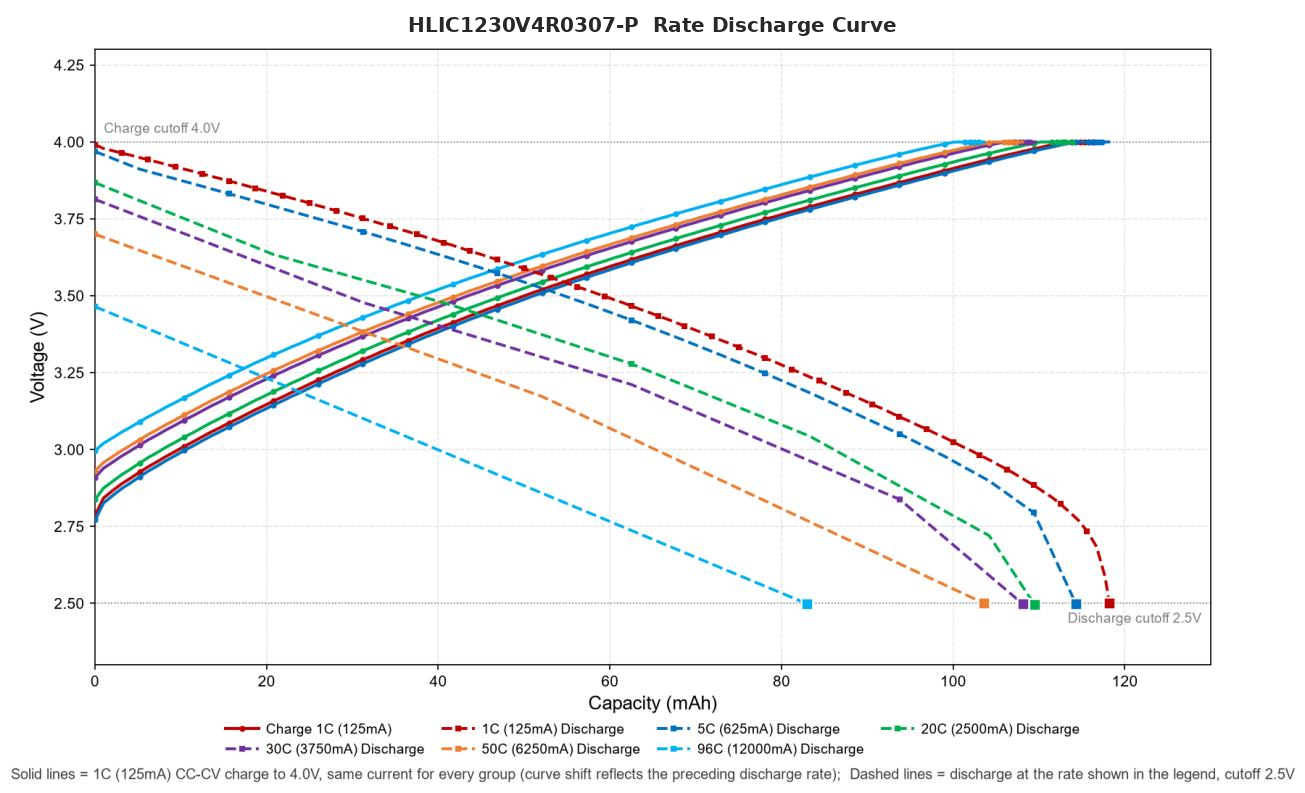
Voltage–capacity curves at 25°C. 1C: 118.0 mAh (100%) | 50C: 103.8 mAh (88% retention) | 96C: 82.3 mAh (70% retention). Sustains ultra-high current pulse with minimal internal drop.
Rate Charge (30C vs 1C)
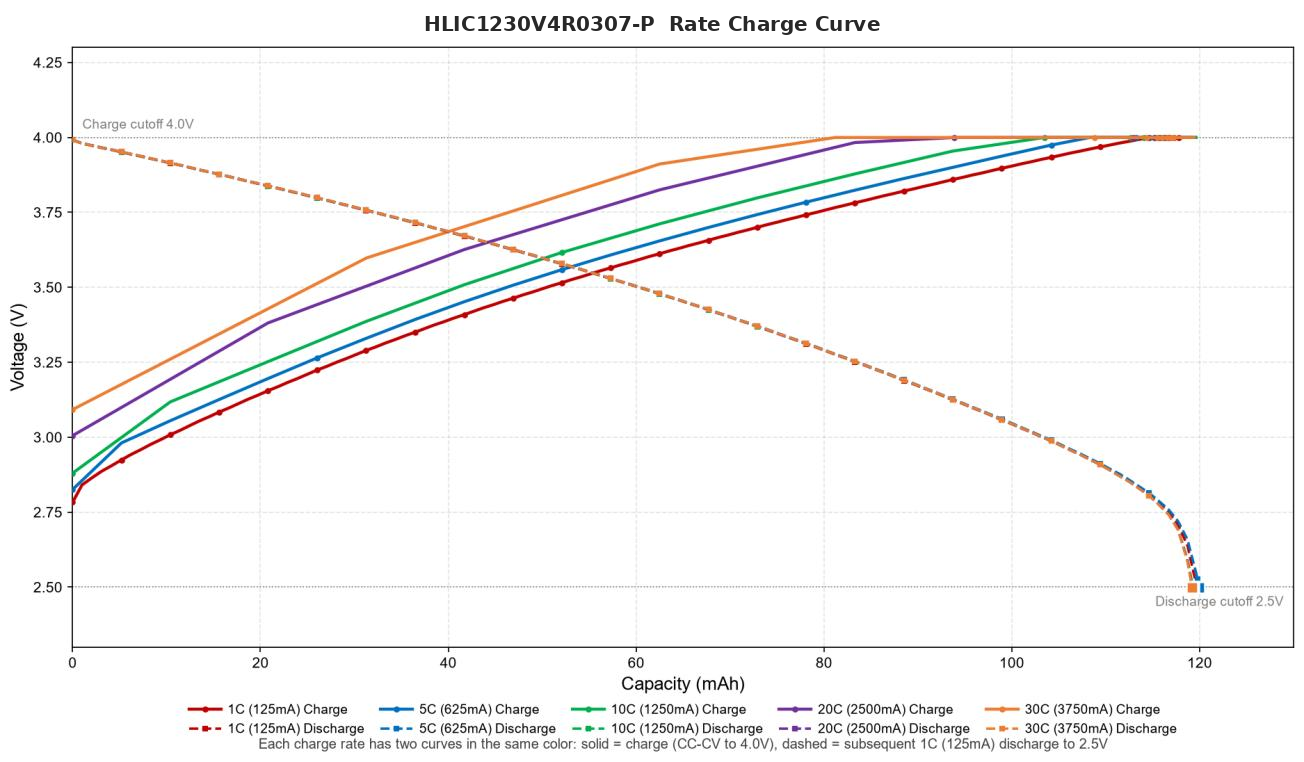
Fast-charging voltage–capacity profiles at 25°C. The 30C charge curve is virtually identical to 1C, proving sub-minute ultra-fast energy replenishment with negligible loss.
Constant Power (2W – 8W)
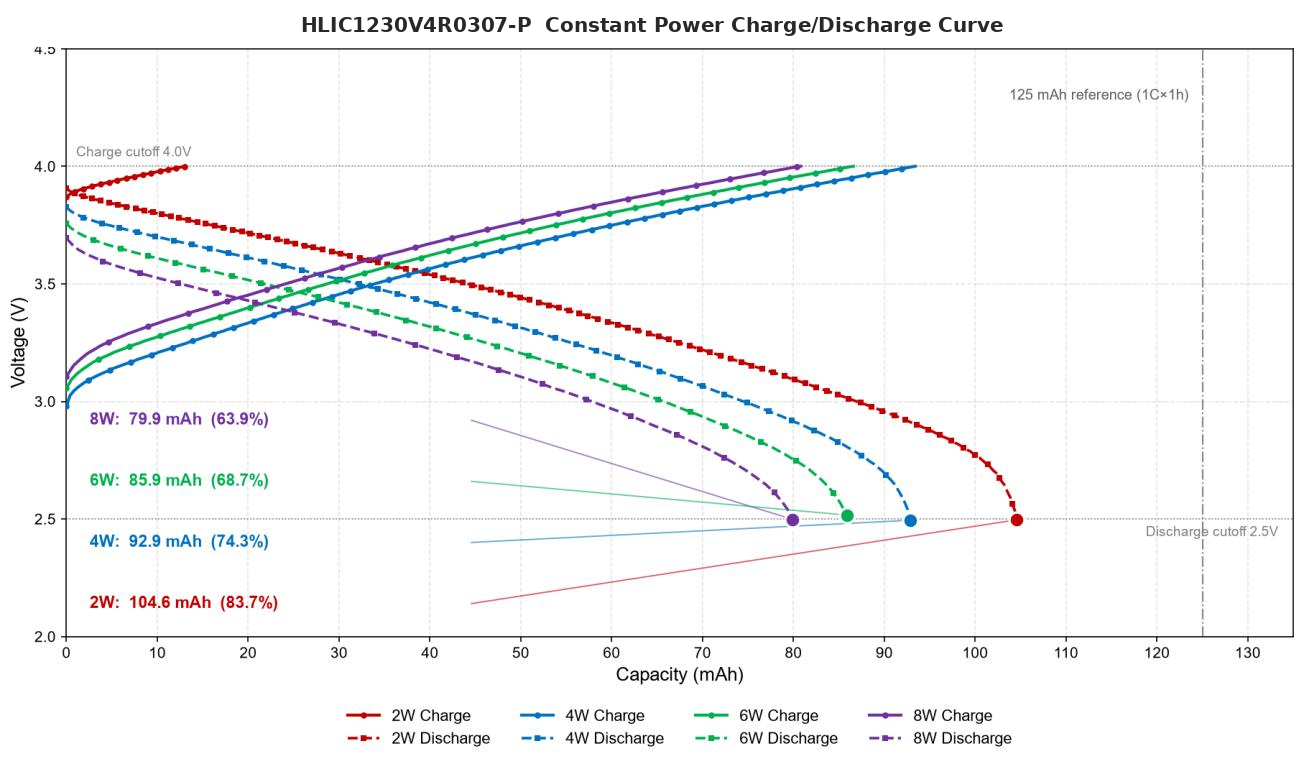
2W / 4W / 6W / 8W constant-power charge (solid) and discharge (dashed) curves, validating voltage platform stability under variable electronic bus loads.
Summary: Key Rate & Power Data (HLIC1230V4R0307-P)
| Test Item | Test Condition | Measured Result | Engineering Significance |
|---|---|---|---|
| Rate Discharge | 1C / 50C / 96C (25 °C) | 118.0 / 103.8 (88%) / 82.3 mAh (70%) | Superior discharge capacity retention at 100C-grade peak rates |
| Rate Charge | 30C vs. 1C (25 °C) | 30C curve close to 1C baseline | Instantaneous energy capture with near-zero capacity loss |
| Constant Power | 2W / 4W / 6W / 8W loads | Stable voltage discharge platform | Reliable power supply for server bus & robotics servo drivers |
20C Accelerated Cycle Life Curve
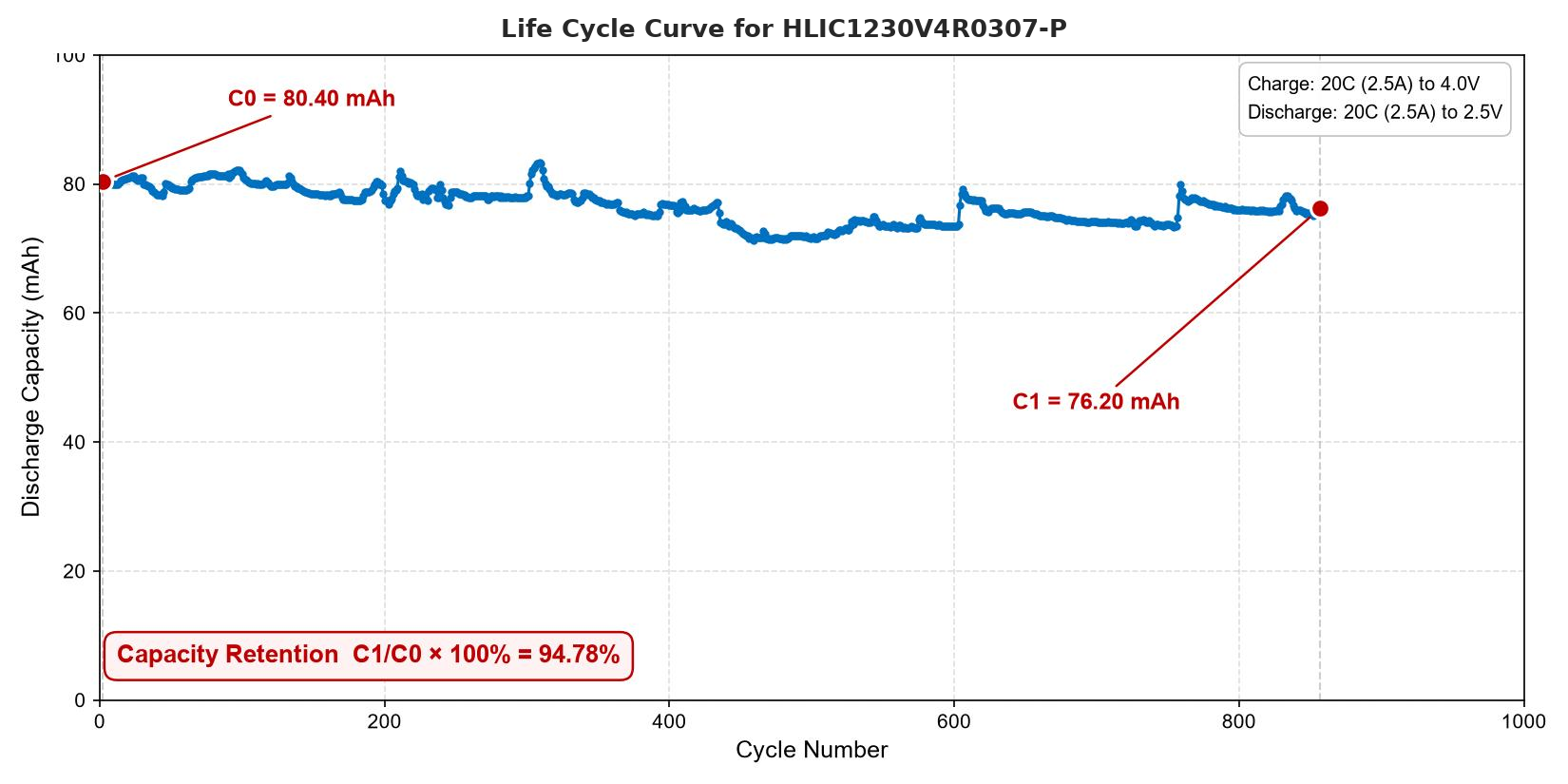
Capacity retention vs. continuous heavy cycling (4.0V ↔ 2.5V, 25 °C ambient). After 850 continuous cycles at 20C ultra-high rate, measured capacity retention remains at 94.78% (C0 80.40 → C1 76.20 mAh).
Factory Cycle Life Standards
| Condition | Cycles | Retention |
|---|---|---|
| 20C Heavy Pulse | 5,000 cycles | ≥ 75% |
| 1C Standard Duty | 20,000 cycles | ≥ 75% |
| Calendar Shelf Life | 2 years @3.6V | ≥ 90% |
Official Test Reports On File
Third-party accredited laboratory test reports for rate discharge, high-temperature floating life, and mechanical safety tests (UL 810A / UN38.3) are available for engineering evaluation upon request.
Low-Temp. Discharge (-25 °C @ 48C)
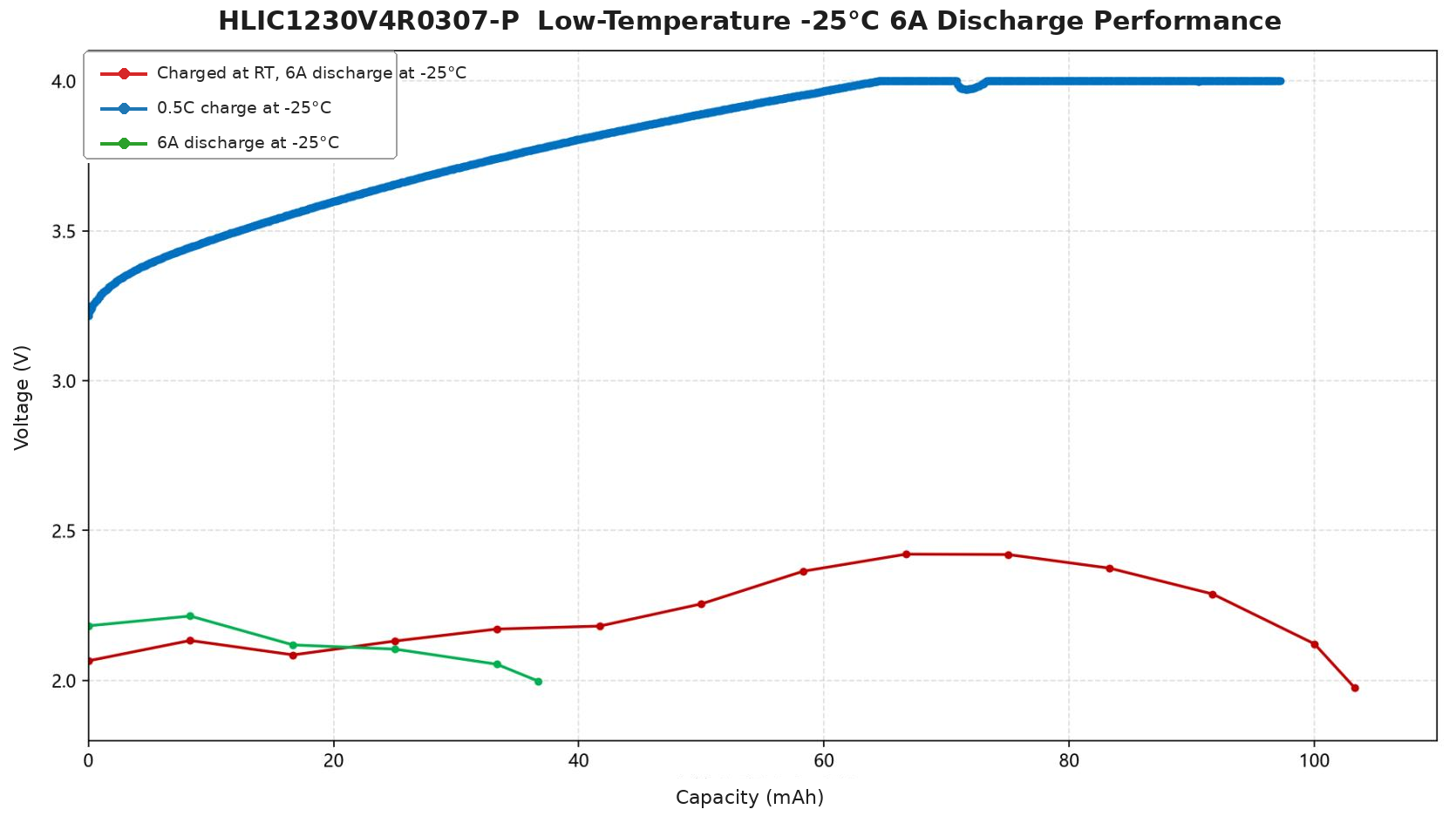
6A (48C rate) discharge curve under extreme -25 °C ambient freeze. Proves reliable heavy pulse deliverability without thermal pre-heating.
Temperature vs. Capacity & ESR
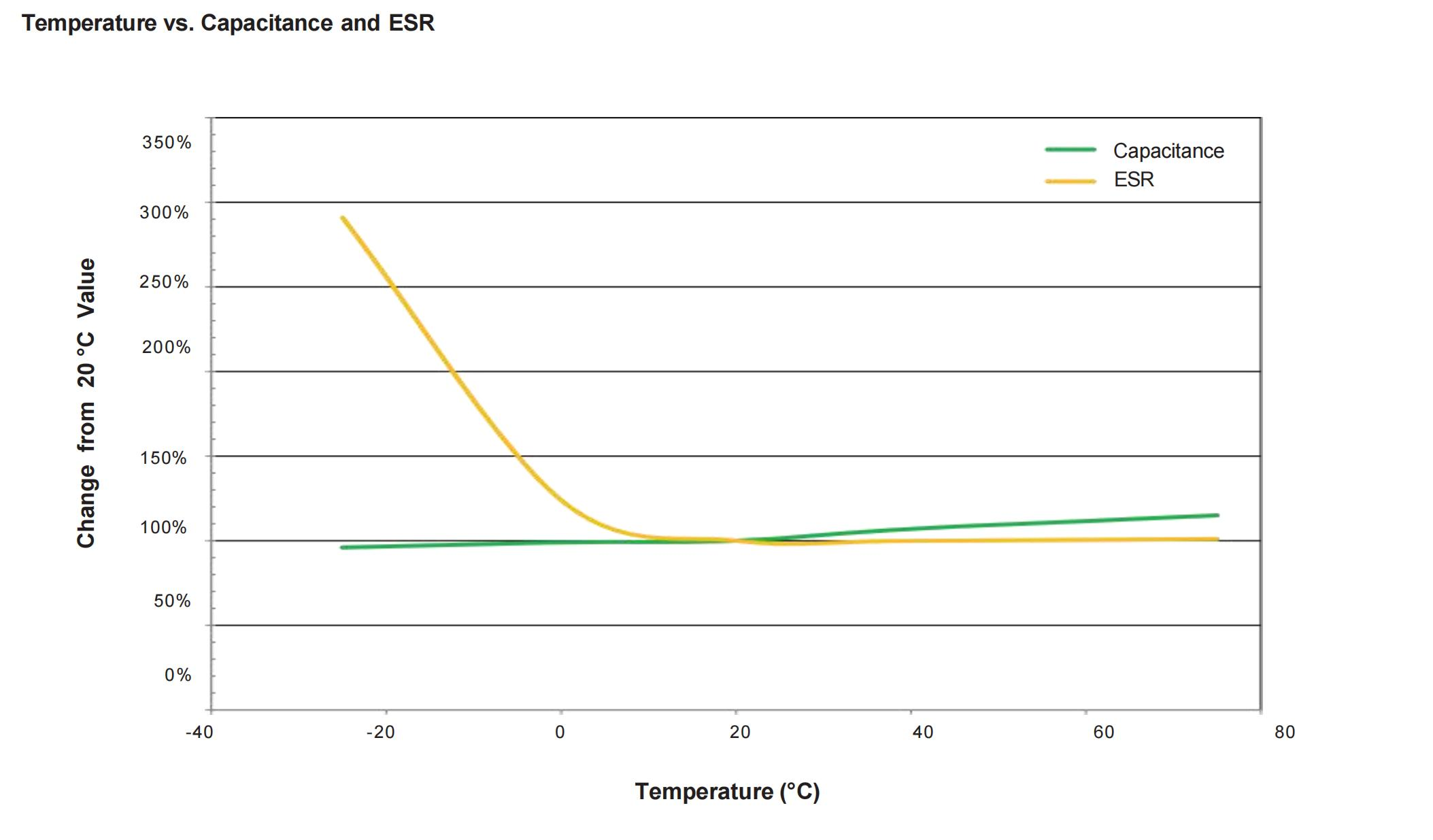
Capacitance and internal ESR response normalized to +20°C baseline. Demonstrates gradual physical ESR rise in sub-zero temps while retaining high active energy content.
Operating Temperature Comparison Across Families
| Series | Operating Temp. Range | Low-Temperature Discharge Performance |
|---|---|---|
| 4.0V Series | -30 °C ~ +70 °C | ≥60% capacity retention at 20C high-rate discharge at -25 °C |
| 3.6V Series | -20 °C ~ +80 °C | Higher high-temp ceiling (+80°C) — ideal for automotive cabin & smart meters |
| 2.7V Series | -45 °C ~ +80 °C | Deep arctic capability — delivers steady power buffer down to -45 °C without heating |
Handling, Safety & Standard Packaging
Technical handling guidelines, mandatory safety boundaries, and export packaging specifications applicable across all 4.0V, 3.6V, and 2.7V families. Soldering profiles and packing quantities for individual parts are governed by their respective engineering datasheets.
01 Assembly & Handling Notes
- Soldering Process: +350 °C for 4–5 s maximum with manual soldering iron; manual soldering is generally not recommended for volume production. Adhere strictly to the recommended reflow profile.
- PCB Cleaning: Avoid board-level aqueous/solvent washing. If cleaning is unavoidable, verify solvent chemical compatibility with the aluminium case and rubber sealing plug beforehand.
- Lead Polarity: Radial pins are polarized — the longer lead is Positive (+). Verify PCB silkscreen alignment and polarity markings prior to automated insertion.
- Handling Rules: Zero reverse voltage, zero overvoltage, no mechanical lead bending without proper jig support, and no disassembly.
02 Mandatory Safety Boundaries
- Intrinsic Safety: Lithium-ion capacitor chemistry is inherently non-volatile and does not exhibit classic thermal runaway under UL 810A testing.
- Voltage Safeguards: Strictly operate within rated upper working voltage (e.g. 4.0V max); never exceed specified peak surge voltages under dynamic transient spikes.
- Thermal Limits: Deploy strictly within datasheet operating temperatures; isolate cells from adjacent power semiconductor heat sinks.
- Storage Protocols: Store in a cool, dry room environment (<30°C, <60% RH). For long-term warehousing (>6 months), maintain cells within the recommended storage voltage range.
03 Packaging & Logistics Standards
- Standard Bulk Packing: Radial cells bulk packaged in moisture-proof anti-static bags. Ø4–10 mm: 2,400 pcs/bag; Ø12–24 mm: packaged per specific cell diameter.
- SMT Reel / Tray Options: Tape & reel, extruded tube, or customized thermoformed trays available on request to interface directly with customer pick-and-place lines.
- Laser Product Marking: High-contrast laser/ink marking indicates manufacturer, capacitance (F), voltage (V), part model, and polarity indication.
- International Shipping: Certified UN38.3 non-hazardous cargo compliance; shipped globally with Dangerous Goods / Air Transport Appraisal reports and MSDS.