





Suggested URL: /lithium-ion-capacitor-working-principle/
Meta Title: Lithium-Ion Capacitors: Working Principle and Technology
Meta Description: Understand how lithium-ion capacitors work, how their hybrid electrode structure differs from batteries and supercapacitors, and where LIC technology offers advantages.
1. Introduction: A Hybrid Approach to Energy Storage
Energy storage systems are increasingly required to deliver both high energy and high power. In many applications, conventional lithium-ion batteries provide substantial energy capacity but may not be ideal for repeated high-power pulses or extremely frequent charge-discharge events. Traditional electric double-layer capacitors (EDLCs), on the other hand, offer excellent power capability and rapid response but generally store less energy per unit of mass or volume.
The Lithium-Ion Capacitor (LIC) was developed to address part of this performance gap.
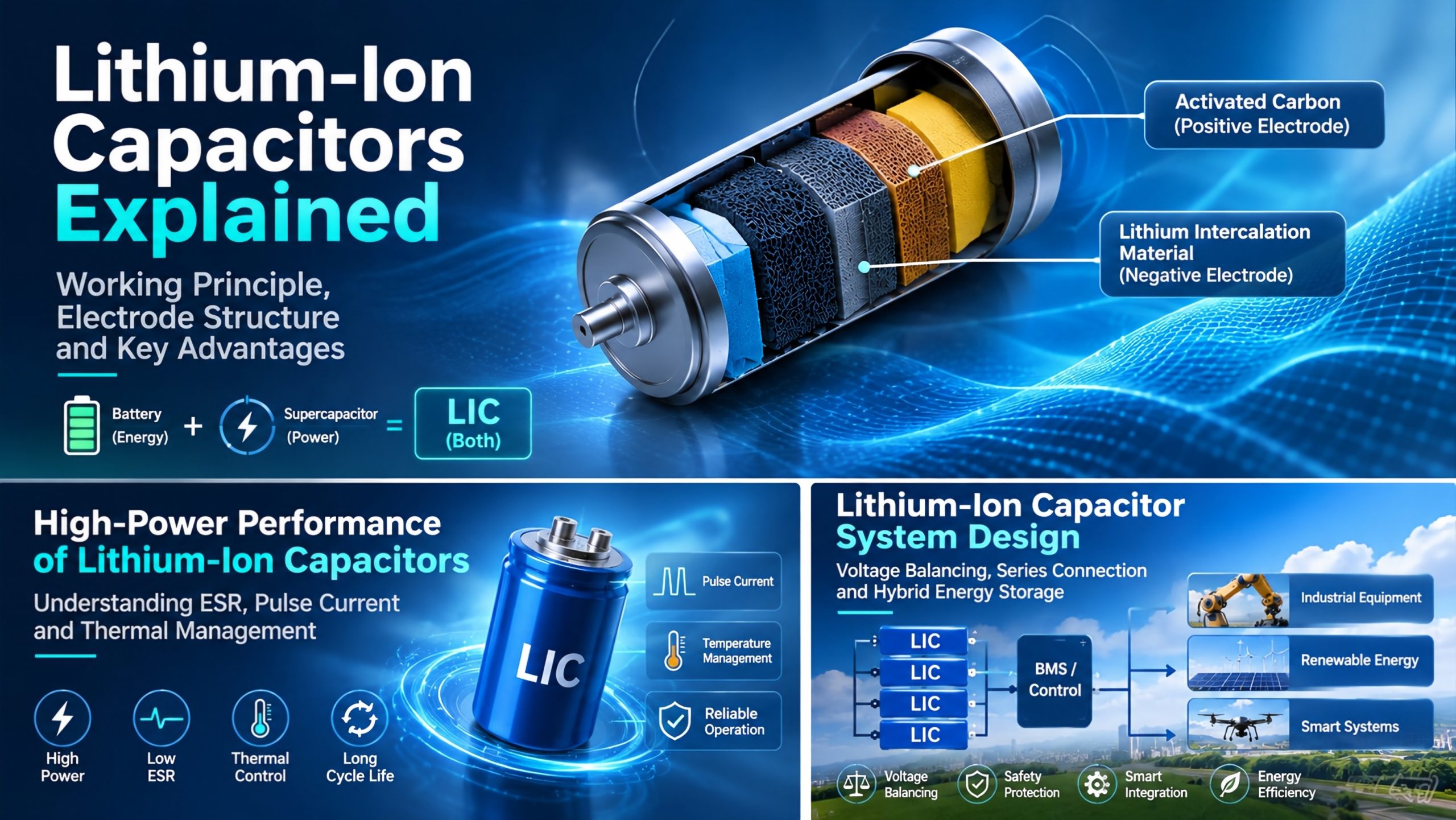
LIC is a hybrid electrochemical energy storage device that combines characteristics of lithium-ion battery technology and electric double-layer capacitor technology. Its asymmetric electrode design allows it to achieve a different balance of energy storage, power delivery and cycling performance compared with either technology alone.
Rather than simply being a battery with a higher charging speed, an LIC uses a different charge-storage mechanism at its positive and negative electrodes.
2. How Does a Lithium-Ion Capacitor Work?
A conventional LIC generally consists of two different electrodes:
- Positive electrode: Typically activated carbon, which stores charge primarily through electrostatic ion adsorption and desorption.
- Negative electrode: Typically a lithium-ion intercalation material, such as pre-lithiated graphite or hard carbon.
During charging, lithium ions move through the electrolyte and are inserted into the negative electrode. At the positive electrode, electrolyte anions are adsorbed onto the activated carbon surface.
During discharge, these processes are reversed.
This asymmetric mechanism is the foundation of LIC technology.
Unlike a conventional EDLC, which uses similar capacitive charge-storage mechanisms at both electrodes, an LIC combines a battery-type negative electrode with a capacitor-type positive electrode.
This allows the device to operate with a higher cell voltage and potentially achieve higher energy storage than a conventional EDLC, while retaining important capacitive characteristics.
3. Why Is Pre-Lithiation Important?
Pre-lithiation is one of the key technologies used in many LIC designs.
In a typical lithium-ion capacitor, the negative electrode needs an initial supply of lithium ions to establish its operating potential and support reversible lithium-ion insertion and extraction.
Without suitable lithium pre-doping, irreversible reactions during initial operation can consume available lithium and reduce the effective performance of the device.
Pre-lithiation helps to:
- Establish the required negative-electrode potential.
- Compensate for initial irreversible lithium consumption.
- Improve the effective utilization of the electrode system.
- Support the design of a wider operating voltage window.
- Contribute to improved energy-storage performance and cycling stability.
However, pre-lithiation is not simply a single manufacturing step. Its degree, uniformity and process control can influence the final electrochemical performance of an LIC.
The electrode materials, mass ratio, electrolyte formulation and formation process must be designed as a coordinated system.
4. LIC vs. Lithium-Ion Batteries vs. Supercapacitors
The three technologies have different strengths.
| Characteristic | Lithium-ion battery | EDLC supercapacitor | LIC |
|---|---|---|---|
| Energy storage | High | Relatively low | Intermediate, design-dependent |
| Power delivery | Design-dependent | Very high | High |
| Charge/discharge response | Moderate to fast | Very fast | Fast |
| Cycle life | Generally lower than capacitors | Very high | Generally high |
| Charge-storage mechanism | Battery-type electrochemical reactions | Electrostatic adsorption | Hybrid mechanism |
| Main design focus | Energy capacity | Power and capacitance | Balance of energy and power |
These are general technology-level comparisons. Actual performance depends on electrode chemistry, cell design, operating voltage, temperature and test conditions.
An LIC should not automatically be considered a direct replacement for either a battery or a supercapacitor. Its value comes from matching the storage characteristics to the actual operating requirements.
5. Key Technical Parameters of an LIC
When evaluating an LIC, several parameters should be considered together.
Capacitance (F)
Capacitance indicates the amount of charge stored per unit change in voltage. It is one of the fundamental electrical characteristics of a capacitor.
Rated Voltage (V)
The rated voltage defines the specified upper operating limit under the manufacturer’s conditions. Exceeding this limit can accelerate degradation or create safety risks.
Equivalent Series Resistance (ESR)
ESR represents the internal resistive component of the device. It affects voltage drop, power capability and heat generation during operation.
Energy Storage (Wh)
The theoretical energy available between two voltage limits is:
\[ E=\frac{1}{2}C(V_{\max}^{2}-V_{\min}^{2}) \]
where:
- \(E\) is energy in joules.
- \(C\) is capacitance in farads.
- \(V_{\max}\) is the upper voltage limit.
- \(V_{\min}\) is the lower voltage limit.
To convert joules into watt-hours, divide by 3,600.
Importantly, usable energy depends on the permitted operating voltage window, not just the maximum rated voltage.
Cycle Life
Cycle life describes how many charge-discharge cycles a device can complete before reaching a defined performance-degradation threshold. The test current, voltage window, temperature and end-of-life criteria must always be considered.
6. Where Does LIC Technology Offer Value?
LIC technology can be considered for systems that require frequent energy exchange, high pulse power or a combination of energy storage and power buffering.
Potential applications include:
- Industrial backup power systems.
- Peak-power compensation.
- Renewable energy systems.
- Regenerative energy recovery.
- Smart meters and remote monitoring equipment.
- Hybrid battery-capacitor energy storage systems.
- Industrial equipment with frequent load fluctuations.
In these applications, an LIC may help reduce short-duration power stress on the main energy source and provide rapid energy delivery when required.
7. Conclusion
Lithium-ion capacitors represent an important development in hybrid energy storage technology.
Their combination of activated-carbon positive electrodes, lithium-ion-based negative electrodes and controlled pre-lithiation enables a performance balance that differs from conventional batteries and EDLC supercapacitors.
For engineers and system designers, the most important consideration is not simply whether an LIC offers higher energy or higher power. It is whether its voltage window, ESR, current capability, thermal characteristics and cycle life match the intended application.
The real value of LIC technology lies in the balance between energy, power and operating life.
Technical references