




Advanced LIC Technology for AI Computing, Industrial Equipment, and Robotics
As AI computing infrastructure, industrial automation, and intelligent robotics continue to advance, power systems are facing increasingly complex challenges. Rapid load fluctuations, instantaneous current demand, and frequent charge-discharge cycles place greater demands on power supply stability and energy storage performance.
Conventional lithium-ion batteries are primarily designed for energy storage, while traditional supercapacitors focus on high-power delivery. For applications requiring both rapid power response and practical energy storage capability, Lithium-Ion Capacitors (LICs) offer an advanced hybrid solution.
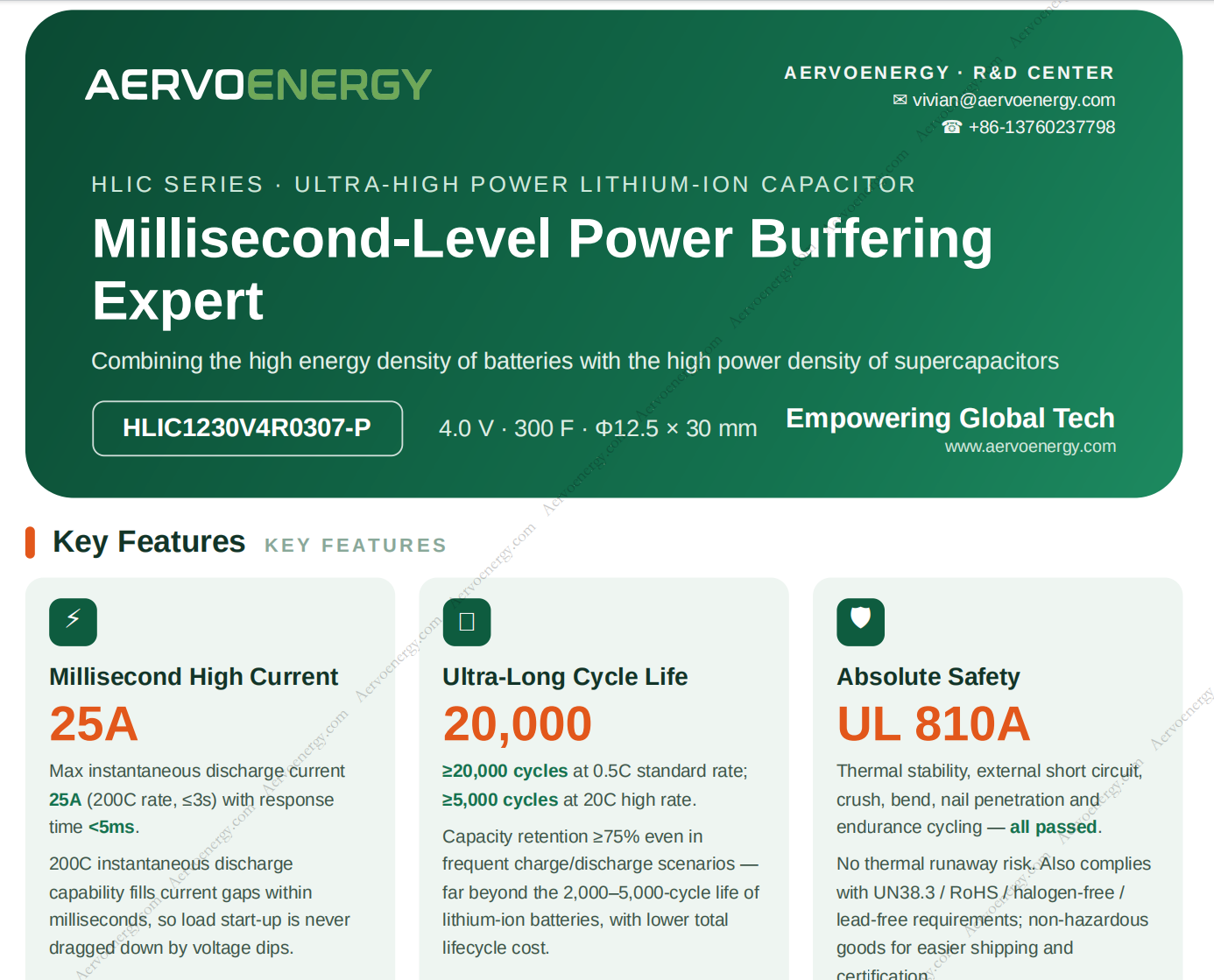
AervoEnergy HLIC1230V4R0307-P is a 4.0V, 300F high-power lithium-ion capacitor engineered for millisecond-level power buffering, transient current compensation, and high-cycle operation.
With a maximum instantaneous discharge current of 25A, a response time of less than 5ms, and an extended cycle life of up to 20,000 cycles under specified conditions, this LIC cell is designed to address demanding power fluctuations in modern electronic and industrial systems.
What Is a Lithium-Ion Capacitor (LIC)?
A Lithium-Ion Capacitor (LIC) is a hybrid energy storage device that combines the characteristics of lithium-ion batteries and electric double-layer capacitors.
By integrating a lithium-ion battery-type negative electrode with a capacitor-type positive electrode, LIC technology provides a balance between energy storage capability and high-power performance.
Compared with conventional energy storage technologies, LICs are particularly suitable for applications involving:
- Short-duration high-power demand
- Rapid charge and discharge
- Repetitive transient load fluctuations
- High-frequency energy buffering
- Long-cycle industrial operation
LIC technology provides a practical option for power systems that require rapid energy response without relying exclusively on conventional battery storage.
Key Performance Features of HLIC1230V4R0307-P
1. Millisecond-Level Power Response
In power-sensitive systems, even a brief delay in supplemental current delivery can result in voltage fluctuations or transient power instability.
The HLIC1230V4R0307-P supports a response time of less than 5ms, enabling rapid power compensation during transient load events.
Its maximum instantaneous discharge current reaches 25A, with a specified 200C instantaneous discharge capability for up to 3 seconds.
These characteristics make the LIC cell suitable for applications requiring short-duration current support, peak power buffering, and rapid energy delivery.
Potential benefits include:
- Fast transient current compensation
- Short-duration peak load support
- Reduced impact of sudden current demand
- Improved power response in dynamic load systems
2. Ultra-Long Cycle Life for High-Frequency Operation
Cycle life is a critical consideration in applications involving repetitive charge and discharge.
The HLIC1230V4R0307-P offers:
- ≥20,000 cycles at a 0.5C standard rate
- ≥5,000 cycles at a 20C high rate
- ≥75% capacity retention under the specified frequent charge-discharge test conditions
This extended cycle life makes the cell suitable for high-frequency power buffering applications where conventional energy storage solutions may require more frequent replacement.
For industrial equipment manufacturers and system integrators, long cycle life can contribute to improved equipment availability and lower lifecycle maintenance costs.
Actual cycle life depends on operating voltage, current, temperature, and charge-discharge conditions.
3. High-Rate Charge and Discharge Capability
Transient power buffering systems often require energy to be transferred rapidly between the storage device and the load.
The HLIC1230V4R0307-P is designed for high-rate charge and discharge operation, supporting applications involving repetitive instantaneous power demand.
This capability is particularly relevant to:
- AI computing power supply systems
- Industrial pulse power compensation
- Robotic actuator power buffering
- Electronic equipment transient current support
- High-frequency energy recovery systems
With appropriate system integration, LIC cells can absorb energy during low-demand periods and release supplemental power during peak load events.
4. Advanced Safety and Reliability Performance
Safety and reliability are essential for energy storage components integrated into electronic and industrial systems.
The HLIC1230V4R0307-P has undergone the following specified safety and endurance tests:
- Thermal stability testing
- External short-circuit testing
- Crush testing
- Bending testing
- Nail penetration testing
- Endurance cycling testing
The product has passed the specified UL 810A-related testing indicated in its product materials.
The cell is also listed as complying with UN38.3, RoHS, halogen-free, and lead-free requirements.
These test and compliance attributes support product evaluation for demanding applications. Final system safety depends on the complete electrical design, protection mechanisms, operating conditions, and integration architecture.
5. Compact Design for Space-Constrained Applications
The HLIC1230V4R0307-P features a compact cylindrical form factor.
Key specifications:
| Parameter | Specification |
|---|---|
| Model | HLIC1230V4R0307-P |
| Product Type | Lithium-Ion Capacitor (LIC) |
| Rated Voltage | 4.0V |
| Capacitance | 300F |
| Dimensions | Φ12.5 × 30mm |
| Maximum Instantaneous Discharge Current | 25A |
| Instantaneous Discharge Rate | 200C, ≤3s |
| Response Time | <5ms |
| Cycle Life at 0.5C | ≥20,000 cycles |
| Cycle Life at 20C | ≥5,000 cycles |
| Capacity Retention | ≥75% under specified test conditions |
The compact dimensions make this LIC cell suitable for integration into space-constrained power buffering modules and electronic systems.
Application Scenarios of High-Power LIC Cells
AI Computing Infrastructure and Data Center Power Systems
AI servers equipped with high-performance GPUs and accelerators can experience rapid changes in power consumption during intensive computing workloads.
These dynamic load characteristics create challenges for power distribution and conversion systems.
High-power LIC cells can be evaluated for localized transient power buffering within suitable rack-level or DC power architectures.
Potential application scenarios include:
- AI server transient power buffering
- GPU power fluctuation compensation
- Rack-level peak power support
- DC power system energy buffering
- Short-duration supplemental power delivery
LIC technology can complement conventional power supply and UPS architectures by addressing rapid load changes. It is not intended to replace long-duration backup power systems.
Industrial Equipment and Pulse Power Compensation
Industrial equipment frequently operates under dynamic electrical conditions involving startup, acceleration, repetitive actuation, and instantaneous current demand.
LIC cells can provide supplemental power during short-duration peak load events.
Potential applications include:
- Industrial automation equipment
- Servo drive systems
- Electromechanical actuators
- High-power electronic equipment
- Industrial pulse power compensation
- Energy recovery and power buffering systems
The rapid response and high-cycle capability of LIC technology make it an attractive option for industrial power management applications.
Robotics and Humanoid Robot Power Systems
Robotic systems require dynamic power delivery during movement, acceleration, and high-load operation.
Robotic joints and actuators may experience instantaneous power requirements significantly higher than their average operating demand.
LIC-based power buffering can be considered for:
- Humanoid robot joint power support
- Robotic actuator peak current compensation
- Dynamic motion power buffering
- High-frequency robotic operation
- Short-duration power demand management
For robotics manufacturers, LIC technology provides an additional approach to addressing peak power demand while supporting repeated high-power operating cycles.
Electronic Systems and Transient Current Compensation
Beyond AI computing, industrial equipment, and robotics, high-power LIC cells can also be evaluated for electronic systems requiring rapid current delivery.
Potential applications include:
- Embedded power systems
- High-performance electronic devices
- Power conversion systems
- Transient voltage support architectures
- High-frequency energy buffering
The appropriate application depends on the required voltage, peak current, energy capacity, and transient duration.
Why Choose AervoEnergy LIC Solutions?
AervoEnergy focuses on advanced energy storage technologies and application-oriented power solutions.
Our LIC product portfolio is designed to support customers seeking high-power energy storage components for demanding operating environments.
We support application evaluation based on:
- Transient power requirements
- Peak and continuous current demand
- Operating voltage
- Charge-discharge frequency
- Required energy capacity
- Operating temperature
- Installation dimensions
- System integration requirements
For AI infrastructure developers, industrial equipment manufacturers, robotics OEMs, and power system integrators, AervoEnergy provides LIC cell selection and customized energy storage solution support.
Conclusion: Millisecond-Level Power Buffering for Next-Generation Systems
As power demand becomes increasingly dynamic across AI computing, industrial automation, and robotics, high-power energy storage technologies are becoming an important part of modern power management systems.
The HLIC1230V4R0307-P combines a compact 4.0V, 300F design with a maximum instantaneous discharge current of 25A, a response time of less than 5ms, and an extended cycle life under specified operating conditions.
Its high-rate charge-discharge capability, long cycle life, and tested safety performance make it a promising candidate for transient power buffering and pulse power compensation applications.
AervoEnergy — Millisecond-Level Power Buffering Expertise for AI Computing, Industrial Equipment, and Robotics.
Contact AervoEnergy to discuss your lithium-ion capacitor requirements and high-power energy storage applications.