





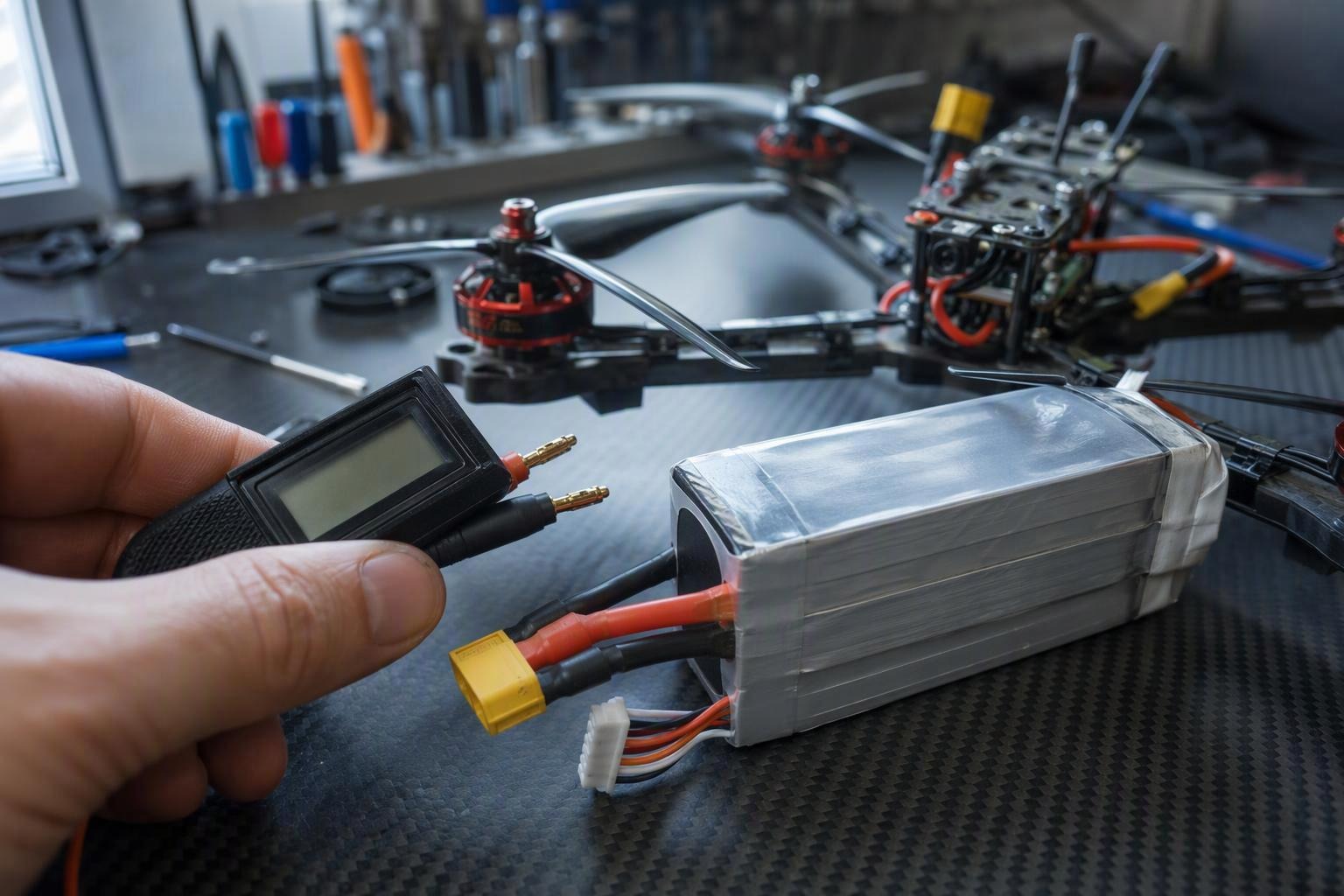
As industrial drones become more sophisticated, battery management is no longer limited to monitoring voltage and estimating remaining capacity. Modern UAV power systems may also need to exchange battery data with flight controllers, onboard computers, ground stations, and charging systems.
The Battery Management System (BMS) plays a central role in this process. In addition to monitoring battery conditions and providing protection functions, a BMS may communicate information such as pack voltage, current, temperature, state of charge, and fault status to other devices.
However, not all battery communication interfaces work in the same way. CAN, SMBus, and UART differ in their communication architecture, electrical interface requirements, data handling, and typical application scenarios.
For UAV manufacturers and battery integrators, selecting the right communication solution requires more than choosing a familiar protocol name. The complete system must be compatible with the aircraft’s hardware, firmware, data definitions, and safety requirements.
1. Why BMS Communication Matters in Drone Battery Systems
A drone battery operates as part of a larger electrical system. The BMS monitors relevant battery parameters, while other onboard systems may need selected information to manage power, display warnings, or support flight decisions.
Depending on the battery design and integration requirements, the BMS may provide:
- State of charge (SOC): An estimate of the remaining battery charge.
- State of health (SOH): An estimate of battery condition relative to a defined reference.
- Pack voltage and current: Information used for power monitoring and energy calculations.
- Cell voltage data: Individual cell measurements, where supported by the BMS.
- Temperature readings: Measurements from selected battery temperature sensors.
- Fault and warning status: Information about conditions such as overvoltage, undervoltage, overcurrent, or excessive temperature.
- Cycle and usage information: Historical data available from the particular BMS implementation.
The availability and accuracy of these data depend on the BMS hardware, firmware, sensing design, and communication specification.
For industrial UAVs, this information can help the aircraft monitor battery conditions and support operational decisions. However, receiving battery data is not the same as having an independent safety protection mechanism. Critical protections must be implemented and validated within the appropriate battery and aircraft control systems.
2. CAN Bus: A Common Choice for Industrial UAV Integration
Controller Area Network (CAN) is a communication protocol widely used in industrial control systems, automotive electronics, and embedded devices. Its robust communication architecture makes it a practical option for many UAV battery systems.
In a CAN-based battery system, the BMS and compatible onboard controllers exchange messages over a shared communication bus.
Key characteristics
Multi-node communication: Multiple compatible devices can communicate on the same bus, subject to network design and message configuration.
Message-based architecture: CAN messages use identifiers and defined data fields rather than relying on a simple point-to-point text stream.
Error detection: CAN includes mechanisms for detecting transmission errors and managing certain communication faults.
Priority-based arbitration: Message identifiers determine arbitration priority, allowing higher-priority messages to gain access to the bus under contention.
These features can make CAN suitable for applications in which the battery must exchange regular status and fault information with a flight controller or onboard power-management system.
What OEM buyers should verify
CAN compatibility does not automatically guarantee that a battery will communicate with a particular drone.
Before selecting a CAN-based battery, confirm:
- CAN protocol version and physical-layer requirements.
- Communication speed and network topology.
- Message identifiers and data-field definitions.
- Byte order, scaling factors, units, and signed-value conventions.
- Message transmission intervals and timeout behavior.
- Fault reporting and communication-loss handling.
- Connector pinout, termination, and electrical compatibility.
For example, two devices may both support CAN but use different message identifiers or interpret the same data field differently. They may therefore be electrically compatible without being application-compatible.
A complete interface specification is essential for reliable integration.
3. SMBus: Smart Battery Data and Standardized Battery Information
System Management Bus (SMBus) is a two-wire communication bus derived from I²C concepts and commonly associated with system monitoring and smart battery applications.
In compatible battery systems, SMBus may be used to read standardized battery information through defined commands. Smart Battery Data implementations can provide information such as voltage, current, temperature, remaining capacity, and battery status.
The exact commands and available data depend on the implementation and supported specification.
Key characteristics
Two-wire communication: SMBus typically uses clock and data lines, with appropriate electrical connections and pull-up arrangements.
Command-based data access: A host requests specific information using defined commands and receives the corresponding response.
Structured battery information: Compatible implementations can expose standardized battery parameters, helping reduce ambiguity in systems designed around the same specification.
Established smart battery ecosystem: SMBus is used in various battery-powered electronic systems, although its suitability for a UAV depends on the aircraft’s architecture.
When SMBus may be suitable
SMBus can be useful when a host system is designed to communicate with a compatible smart battery and requires structured battery status information.
However, SMBus should not be assumed to be the best choice for every industrial drone. OEMs must consider electrical interface requirements, communication timing, cable length, environmental conditions, host support, and the need for real-time system integration.
For a UAV using a flight controller that expects a different battery interface, an SMBus battery may require additional hardware or software integration.
4. UART: A Flexible Serial Interface for Embedded Systems
Universal Asynchronous Receiver/Transmitter (UART) is a hardware communication interface commonly used in embedded systems.
Unlike CAN, UART does not inherently define a complete multi-node network protocol. It provides serial data transmission, while the devices or firmware determine how that data is organized and interpreted.
A UART-based BMS may transmit battery parameters using a vendor-defined binary format, a structured command-response protocol, or another documented data format.
Key characteristics
Simple serial communication: UART commonly uses separate transmit and receive signals, with a shared reference ground where required by the electrical design.
Flexible data formats: Developers can define message structures, commands, and reporting intervals to suit the application.
Low implementation complexity: UART can be practical for direct communication between a BMS and a compatible embedded controller.
Protocol-dependent functionality: Data integrity checks, message framing, addressing, and error recovery depend on the higher-level protocol implemented over UART.
What OEM buyers should verify
A UART interface alone does not tell the buyer what data the battery can provide or how reliably the system handles communication faults.
Confirm the following before integration:
- Baud rate and serial configuration.
- Electrical voltage levels and interface type.
- Message format and command definitions.
- Checksum or cyclic redundancy check (CRC), if implemented.
- Data update frequency and response timing.
- Timeout handling and invalid-data behavior.
- Connector pinout and wiring requirements.
UART is not inherently differential or noise-immune. If a UAV requires longer cable runs or operates in an electrically noisy environment, the physical interface and installation design must be evaluated carefully.
5. CAN vs SMBus vs UART: What Is the Difference?
The following comparison summarizes their typical characteristics. Actual capabilities depend on the selected implementation and product requirements.
| Feature | CAN | SMBus | UART |
|---|---|---|---|
| Communication architecture | Message-based bus | Two-wire, command-based bus | Serial interface; protocol defined separately |
| Typical physical signals | CAN_H and CAN_L differential pair | Clock and data lines | Typically TX and RX |
| Multiple devices | Supported through compatible bus design | Supported through compatible addressing and bus design | Not inherently a multi-node network |
| Error handling | Built-in CAN error detection mechanisms | Depends on the specification and implementation | Depends on the protocol implemented over UART |
| Battery data format | Defined by the application protocol | Can use Smart Battery Data commands | Often vendor-defined or application-specific |
| Integration requirements | CAN hardware and compatible message definitions | SMBus-compatible host and commands | Matching serial hardware and protocol |
| Typical consideration for UAVs | Robust communication between onboard controllers | Structured smart battery data exchange | Direct communication with embedded controllers |
The table describes general characteristics, not a guarantee of performance in every installation. For example, CAN’s differential signaling can improve noise immunity, but actual reliability still depends on cabling, grounding, termination, topology, and electromagnetic compatibility.
Which protocol should UAV manufacturers choose?
- Consider CAN when the aircraft uses a CAN-based architecture and requires structured communication between the battery and compatible onboard systems.
- Consider SMBus when the host is designed for compatible smart battery data access and the electrical and communication requirements can be met.
- Consider UART when a direct serial interface and a documented, application-specific communication protocol fit the system architecture.
There is no universally best protocol. The right choice is the one that meets the aircraft’s technical requirements and can be validated reliably.
6. Smart Battery Data: More Than Reading Voltage and Capacity
A smart battery can provide information beyond a simple voltage reading. Depending on its design, it may report estimated remaining capacity, charging or discharging current, temperature, battery status, and fault information.
However, the term smart battery does not guarantee that every parameter is available, accurate, or updated at the same rate.
OEM buyers should evaluate several aspects of the data itself.
State of charge accuracy
SOC is an estimate, not a direct measurement of remaining flight time. Its accuracy depends on the estimation method, current measurement, cell characteristics, temperature, operating history, and calibration.
For demanding UAV applications, buyers should ask how SOC is calculated and how its accuracy is evaluated across the expected operating range.
State of health and cycle history
Some BMS implementations provide SOH estimates and accumulated cycle information. The definitions used to calculate these values may differ between manufacturers.
If SOH is used for maintenance planning or battery replacement decisions, the OEM should confirm the calculation method and its limitations.
Cell-level monitoring
A BMS may report individual cell voltages or only pack-level information. Cell-level visibility can help identify voltage imbalance and support diagnostics, but it depends on the hardware, firmware, and available communication bandwidth.
Fault reporting
Fault codes should be documented clearly. OEMs should understand what each code means, the conditions that trigger it, and how the aircraft should respond.
A communication link can deliver fault information, but the aircraft must still interpret that information correctly and implement suitable responses.
7. Communication Compatibility Is a System-Level Requirement
One of the most common integration mistakes is assuming that matching connectors or protocol names is enough to establish compatibility.
In practice, battery integration involves several layers:
Physical interface: Connector, pinout, voltage levels, wiring, grounding, and electrical protection.
Communication protocol: CAN, SMBus, or UART, including the applicable physical-layer and protocol requirements.
Data specification: Message identifiers, command definitions, units, scaling, byte order, and status interpretation.
System behavior: Update intervals, timeouts, fault handling, startup behavior, and recovery after communication loss.
Aircraft integration: Flight-controller support, firmware configuration, monitoring logic, and any required testing.
A battery can pass a basic communication test while still failing to provide the information or timing required by the aircraft.
For this reason, OEMs should obtain the BMS communication specification before finalizing a battery design. Where possible, evaluate the interface using the intended flight controller or a representative integration test setup.
8. What OEM Buyers Should Request from a Battery Supplier
To reduce integration time and avoid unnecessary redesign, buyers should request the following information early in the development process.
- Supported communication interfaces and protocol versions.
- Complete BMS communication or interface specification.
- Connector pinout and electrical characteristics.
- Available battery parameters and data definitions.
- Message identifiers, commands, and reporting intervals.
- Fault codes, timeout behavior, and communication-loss handling.
- Compatibility requirements for the flight controller or onboard computer.
- Relevant test evidence for communication reliability and electrical integration.
For customized battery packs, also confirm the required voltage, capacity, continuous and peak discharge current, dimensions, maximum weight, and operating temperature range.
These parameters influence the battery design alongside the communication interface. A technically compatible protocol cannot compensate for a battery pack that does not meet the aircraft’s power or mechanical requirements.
9. Designing a Better-Integrated UAV Battery Solution
The BMS communication interface should be considered during the early stages of UAV battery development rather than added as an afterthought.
Early coordination between the battery supplier and aircraft engineering team can clarify the required data, interface hardware, message definitions, fault behavior, and integration tests before the battery configuration is finalized.
For industrial and agricultural UAVs, the objective is to combine suitable cell performance, reliable electrical protection, useful battery telemetry, and compatibility with the aircraft’s control architecture.
CAN, SMBus, and UART each serve different integration needs. The best choice depends on the host system, communication requirements, operating environment, and validation plan.
Looking for a UAV Battery with the Right BMS Interface?
AervoEnergy provides UAV battery cell supply and customized battery-pack solutions for industrial and agricultural drone applications.
When evaluating a customized battery solution, OEMs should identify their required communication interface and provide the relevant flight-controller or system-integration requirements. This allows the battery configuration and BMS interface to be reviewed together, subject to technical feasibility and validation.
If you are developing a UAV platform, share your required voltage, capacity, discharge rate, dimensions, weight limit, and BMS communication requirements with our team.
Contact AervoEnergy to discuss your UAV battery integration requirements.
SEO Settings
SEO Title: Drone BMS Communication Protocols: CAN, SMBus and UART
Meta Description: Compare CAN, SMBus, and UART for drone battery management systems. Learn about smart battery data, BMS compatibility, telemetry, and UAV battery integration.
Suggested URL Slug: drone-bms-communication-protocols
Primary Keyword: drone BMS communication protocols
Secondary Keywords: UAV battery BMS, CAN bus drone battery, SMBus smart battery, UART battery communication, smart battery data, UAV battery integration, customized drone battery pack
Suggested Featured Image: A technical illustration of a UAV battery pack connected to a flight controller, showing CAN, SMBus, and UART as alternative communication interfaces.