





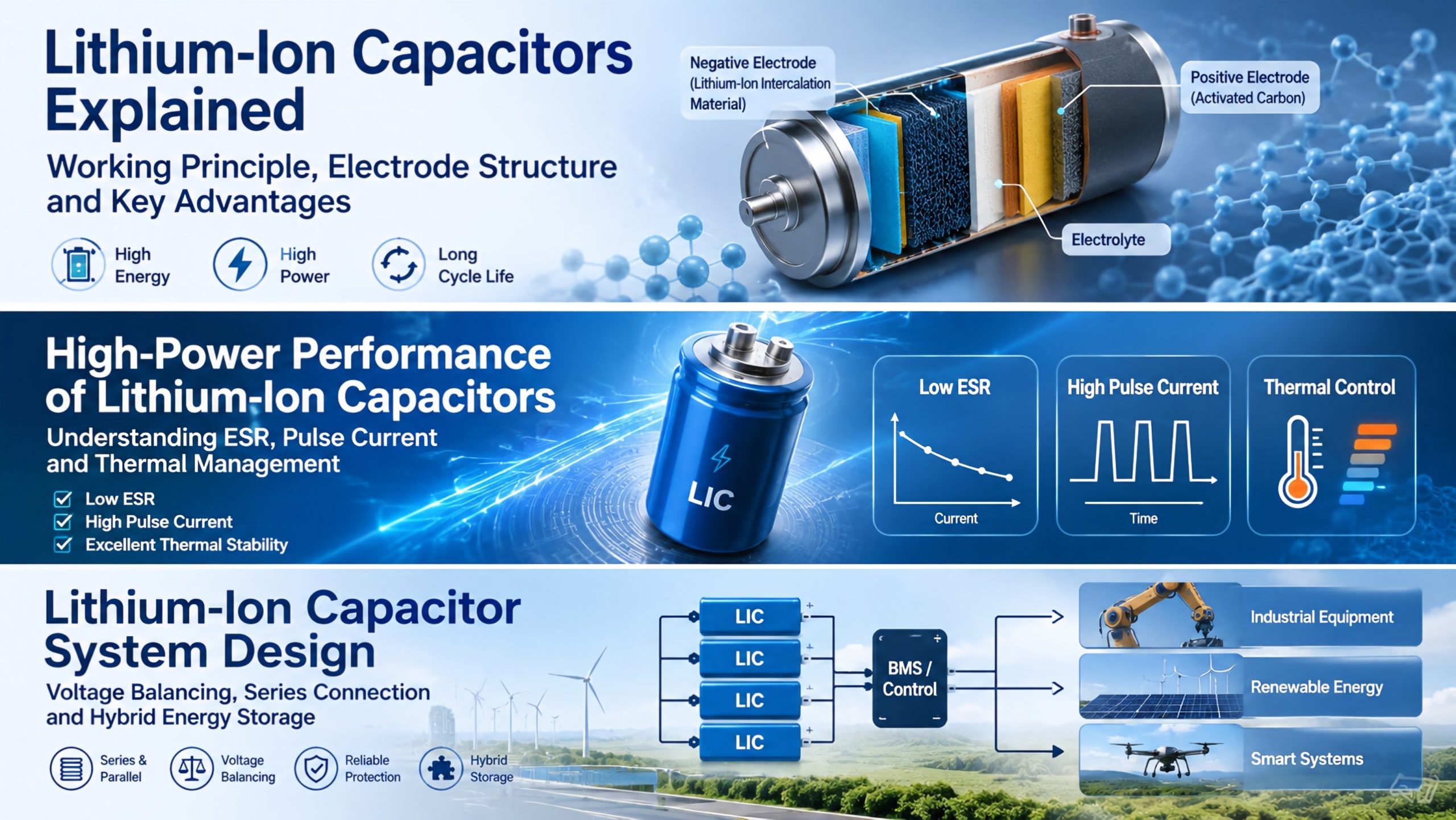
Suggested URL: /lithium-ion-capacitor-system-design-integration/
Meta Title: LIC System Design: Voltage Balancing and Energy Storage Integration
Meta Description: Learn how to integrate lithium-ion capacitors into energy storage systems, including series and parallel configurations, voltage balancing, charging control and hybrid energy storage.
1. Introduction: From Individual Cells to an Energy Storage System
Selecting a suitable Lithium-Ion Capacitor (LIC) cell is only the first step in developing an effective energy storage solution.
In practical applications, individual cells often need to be connected in series or parallel to meet system voltage, capacitance and current requirements.
The resulting system must also address voltage balancing, charging control, protection, thermal management and compatibility with the connected equipment.
A well-designed LIC system is therefore not simply a group of connected cells. It is an integrated electrical and thermal system in which every component must operate within its specified limits.
2. Series Connection: Increasing System Voltage
When LIC cells are connected in series, their voltage ratings add together.
For \(N\) identical cells connected in series:
\[ V_{\mathrm{total}}=N\times V_{\mathrm{cell}} \]
The equivalent capacitance decreases:
\[ C_{\mathrm{total}}=\frac{C_{\mathrm{cell}}}{N} \]
The equivalent ESR increases:
\[ ESR_{\mathrm{total}}=N\times ESR_{\mathrm{cell}} \]
These relationships assume identical cells and idealized connections. Actual system performance is also affected by interconnections, manufacturing tolerances and operating conditions.
Example:
If four identical LIC cells are connected in series, the theoretical system voltage becomes four times the voltage of one cell, while the total capacitance becomes one quarter of the individual cell capacitance.
Series connection is commonly considered when a higher DC bus voltage is required.
However, increasing the number of cells in series also increases the importance of voltage monitoring and balancing.
3. Parallel Connection: Increasing Capacitance and Current Capability
When identical LIC cells are connected in parallel:
\[ C_{\mathrm{total}}=N\times C_{\mathrm{cell}} \]
The equivalent ESR ideally becomes:
\[ ESR_{\mathrm{total}}=\frac{ESR_{\mathrm{cell}}}{N} \]
The system voltage remains the same as the voltage of an individual cell.
Parallel connection can therefore increase total capacitance and reduce the equivalent resistance of the cell group.
However, current sharing should not be assumed to be perfectly equal.
Differences in cell ESR, capacitance, temperature and connection resistance can lead to uneven current distribution.
Proper cell matching, electrical connection design and thermal management are important for reliable parallel operation.
4. Why Voltage Balancing Is Important
In a series-connected LIC string, each cell is expected to operate within its specified voltage range.
However, individual cells may have slightly different capacitance, leakage characteristics, ESR and self-discharge behavior.
As a result, their voltages may not remain perfectly equal during charging and discharging.
One cell may reach its upper voltage limit before the others, or fall below its lower operating limit first.
This creates a risk of operating an individual cell outside its permitted voltage window even when the total pack voltage appears acceptable.
Voltage balancing helps reduce this risk.
Two commonly used approaches are:
Passive balancing
Passive balancing uses resistive elements to reduce voltage differences between cells. It is relatively simple but dissipates excess energy as heat.
Active balancing
Active balancing transfers energy between cells or cell groups. It can reduce energy loss compared with passive balancing, but usually requires a more complex circuit and control strategy.
The appropriate method depends on the system’s voltage, current, operating profile, efficiency requirements and cost targets.
Importantly, balancing design must follow the actual LIC cell specification. It should not simply copy the voltage thresholds or control strategy used for conventional lithium-ion battery packs.
5. Charging Control and Voltage Protection
LICs require controlled charging and discharging within the manufacturer’s specified operating voltage range.
The charging system should consider:
- Maximum permitted cell voltage.
- Minimum permitted cell voltage.
- Charging current limits.
- Discharge current limits.
- Temperature limits.
- Voltage monitoring.
- Overvoltage and undervoltage protection.
- Abnormal operating conditions.
For series-connected systems, individual cell voltage monitoring is especially important.
A system that only monitors total pack voltage may fail to detect an individual cell reaching its upper or lower limit.
The charger, DC/DC converter and protection circuit should therefore be designed around the actual electrical characteristics of the selected LIC.
6. Hybrid Energy Storage: Combining LICs with Batteries
One of the important potential applications of LIC technology is hybrid energy storage.
In a hybrid system, a battery and an LIC can be used together to serve different parts of the load profile.
The battery primarily supplies sustained energy demand, while the LIC can provide or absorb short-duration power fluctuations.
A simplified operating strategy may work as follows:
- Under relatively stable load conditions, the battery supplies the main energy demand.
- When a sudden power peak occurs, the LIC provides additional power.
- During regenerative operation or a suitable charging event, the LIC can absorb energy.
- A power management controller coordinates energy flow between the battery, LIC and connected load.
This arrangement can help reduce rapid power fluctuations experienced by the primary battery, depending on system sizing and control strategy.
However, the benefits are not automatic.
The system requires suitable DC/DC conversion, current control, voltage coordination and energy management.
The battery and LIC must be sized according to the actual load profile rather than simply selecting the largest available capacitance.
7. Applications for LIC-Based Energy Storage Systems
LIC technology may be considered in systems where rapid energy exchange and repeated power fluctuations are important.
Examples include:
Industrial peak-power compensation
LIC modules can provide short-duration power support during sudden increases in equipment demand.
Regenerative energy recovery
In systems with suitable power electronics, LICs can absorb energy generated during braking or deceleration and release it when required.
Renewable energy systems
LICs may help manage short-duration fluctuations in power generation or load demand when integrated with an appropriate control system.
Industrial backup power
LICs can provide rapid power support for selected loads during short interruptions or transient events. Backup duration must be calculated from usable energy and the required load.
Remote monitoring and smart equipment
LICs may be suitable for equipment that requires repeated energy pulses, reliable operation and long service life.
8. Engineering Considerations Before System Integration
Before developing an LIC module, engineers should establish the following design requirements:
| Design factor | Key consideration |
|---|---|
| System voltage | Required DC bus voltage |
| Capacitance | Required energy storage and voltage response |
| ESR | Voltage drop and heat generation |
| Current | Continuous and peak current requirements |
| Voltage balancing | Individual cell voltage control |
| Thermal management | Operating temperature and heat dissipation |
| Charging strategy | Permitted voltage and current limits |
| Protection | Overvoltage, undervoltage and overcurrent |
| Lifetime | Required cycle life and operating conditions |
| Mechanical design | Installation space, vibration and connections |
Testing should be performed at both cell and system levels.
A cell’s individual performance does not automatically guarantee that a complete module will achieve the same performance under actual operating conditions.
9. Conclusion
The successful integration of lithium-ion capacitors requires more than selecting the correct capacitance and rated voltage.
Series and parallel configurations determine system-level electrical characteristics. Voltage balancing helps maintain individual cell operating limits. Charging control and protection support reliable operation. Hybrid energy storage architectures can use LICs to manage short-duration power demand alongside batteries.
For equipment manufacturers and system integrators, the key is to design the LIC around the real operating profile of the application.
A high-performance LIC cell is the starting point. A properly engineered energy storage system is what delivers practical value.
Technical references
- 锂离子电容器在新能源领域应用展望 — review of LIC technology and hybrid energy storage applications.
- Lithium-Ion Capacitors: A Review of Strategies toward Enhancing the Performance of the Activated Carbon Cathode.
- CDA-Zhifengwei LIC Series — manufacturer product information and user documentation.