


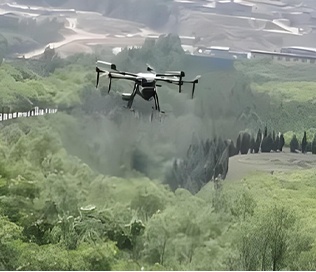


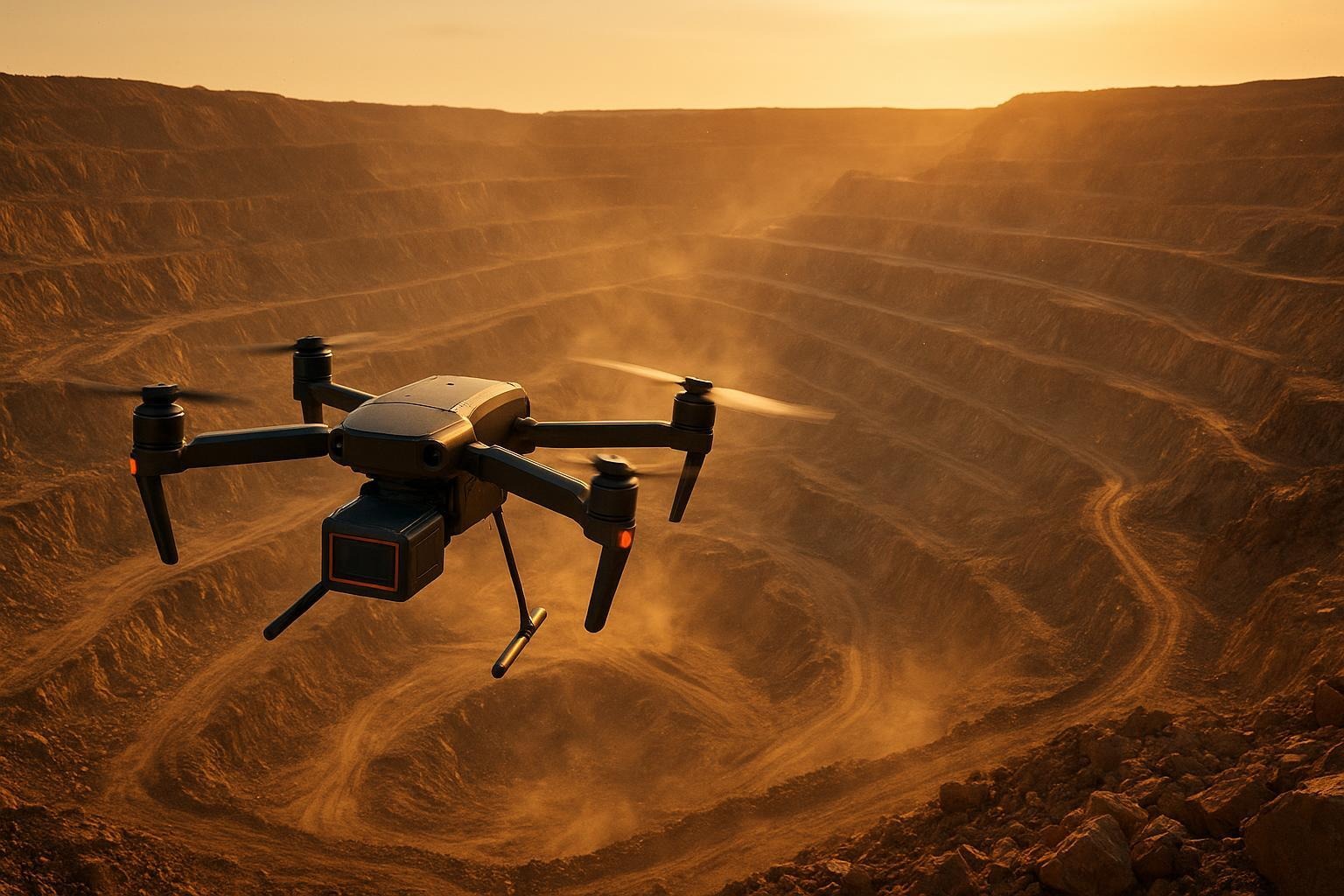
Mining operations place demanding requirements on industrial UAV power systems. Whether used for open-pit mine surveying, stockpile measurement, infrastructure inspection, or underground site assessment, mining drones must operate reliably in environments characterized by airborne dust, mechanical vibration, temperature fluctuations, and repeated takeoffs and landings.
In these conditions, battery performance involves more than nominal capacity or energy density. Voltage stability under load, enclosure protection, mechanical integrity, and thermal management all contribute to reliable flight operations.
For mining drone operators and UAV manufacturers, an effective battery solution must address these factors as an integrated engineering challenge.
1. Why Mining Environments Challenge UAV Battery Performance
Mining sites expose drone batteries to a combination of environmental and operational stresses.
High dust concentrations: Fine mineral particles can accumulate around battery compartments, connectors, cooling passages, and electrical interfaces. Depending on their composition and concentration, conductive or abrasive particles may contribute to electrical faults, corrosion, or accelerated wear.
Mechanical vibration and shock: Uneven terrain, transportation between work areas, takeoff and landing impacts, and aircraft vibration can place repeated mechanical loads on battery housings, internal connections, and mounting structures.
High power demand: Heavy sensor payloads, extended flight distances, strong winds, and frequent changes in flight conditions can increase current demand. Under these conditions, a battery must maintain adequate voltage while supplying the required power.
Temperature variations: Cold conditions can increase battery internal resistance and reduce available power, while elevated temperatures can accelerate degradation and increase thermal-management requirements.
These challenges are interconnected. A battery may have sufficient rated capacity yet still be unsuitable for a mining UAV if its voltage drops excessively during high-current operation or its enclosure and electrical connections cannot withstand the operating environment.
2. Understanding Voltage Sag in Mining Drone Batteries
Voltage sag is the temporary decrease in battery terminal voltage when the battery supplies current under load.
A simplified relationship is:
Voltage Sag ≈ Current × Effective Internal Resistance
The loaded terminal voltage can be approximated as:
V_loaded ≈ V_open-circuit − I × R_effective
Here, the effective resistance represents the combined electrical resistance of the cells and relevant current-carrying components. Actual voltage behavior also depends on electrochemical polarization, temperature, state of charge, and the duration of the load.
For mining drones, voltage sag becomes particularly important during takeoff, rapid climbing, acceleration, and other high-power flight maneuvers.
Excessive voltage reduction can cause several operational problems:
- Reduced power margin: Lower terminal voltage may limit the power available to the propulsion system.
- Premature low-voltage warnings: Voltage thresholds may be reached before the battery’s nominal capacity is fully utilized.
- Unexpected flight limitations: The aircraft may need to reduce power or initiate a return-to-home or landing procedure, depending on its control-system configuration.
- Increased electrical stress: Higher current for a given power demand can increase resistive losses and heat generation.
The actual risk depends on the UAV’s electrical architecture, battery-management strategy, flight controller settings, and motor-controller operating limits.
Key factors that influence voltage sag
Cell internal resistance
Cell chemistry, design, manufacturing consistency, age, and degradation influence internal resistance. Cells selected for high-power UAV applications should be evaluated using discharge testing under representative current and temperature conditions.
State of charge
As the battery discharges, its open-circuit voltage changes. Available power and voltage stability may become more constrained at lower states of charge, depending on the cell design.
Operating temperature
Low temperatures can increase internal resistance and reduce available discharge capability. High temperatures may temporarily affect electrical behavior but can also accelerate long-term degradation.
Electrical interconnections
Busbars, cables, connectors, welds, and other current-carrying components contribute to total resistance. Loose, damaged, undersized, or poorly assembled connections can increase voltage drop and localized heating.
Battery configuration
Series-parallel configuration, current distribution, cell matching, and the continuous and peak discharge requirements all affect the suitability of a battery pack for a particular aircraft.
For this reason, preventing voltage sag requires coordinated cell selection, pack design, electrical integration, and application-specific validation.
3. Dust-Tight Sealing: Protecting Battery Integrity in Mining Operations
Dust protection is an important consideration when designing battery packs for mining drones. Fine particles can enter through enclosure joints, cable interfaces, connector openings, and poorly protected service points.
A properly engineered enclosure helps reduce contamination risks and supports long-term electrical reliability.
Enclosure design and ingress protection
Battery enclosures should be designed around the actual dust exposure, moisture conditions, operating temperature, and maintenance requirements of the target mining environment.
Relevant design considerations include:
- Sealed enclosure joints and appropriately selected gaskets.
- Protected cable entries and connector interfaces.
- Secure covers and fasteners that resist loosening under vibration.
- Appropriate protection for external terminals and electrical interfaces.
- Verified ingress-protection performance where a specific IP rating is required.
An IP rating should only be claimed when supported by the applicable test results for the relevant enclosure or assembled product. Dust resistance should not be assumed solely because a housing appears tightly sealed.
Sealing must work with thermal management
Dust-tight construction introduces another engineering consideration: heat dissipation.
During high-current discharge, cells and electrical connections generate heat. An enclosure that restricts airflow may increase internal temperatures if its thermal design is inadequate.
A suitable solution may use engineered heat-transfer paths, thermally conductive structural components, or other cooling arrangements appropriate to the aircraft’s design.
The objective is to balance environmental protection with temperature control, weight, packaging constraints, and serviceability.
Important distinction: Dust-tight sealing does not directly eliminate electrochemical voltage sag. Its value lies in helping protect the electrical and mechanical integrity of the battery system, reducing contamination-related risks that could otherwise compromise reliable operation.
4. Shock Resistance and Vibration Control: Protecting the Battery Pack
Mining drones frequently operate around uneven terrain and may experience vibration during flight, transport, takeoff, and landing. These conditions can affect not only the enclosure but also the cells and electrical connections inside the battery pack.
Shock-resistant battery design should therefore consider the complete mechanical assembly rather than relying on a robust outer shell alone.
Mechanical retention and structural support
Cells must be securely retained to prevent excessive movement within the pack. Appropriate support structures help distribute mechanical loads and reduce localized stress.
The design should account for:
- Cell positioning and retention.
- Housing stiffness and fastening methods.
- Vibration isolation where appropriate.
- Protection of cables, connectors, and electrical joints.
- Mounting-interface loads transmitted from the aircraft.
- Mechanical clearances that prevent abrasion or unwanted contact.
The appropriate arrangement depends on cell format, pack dimensions, aircraft mounting geometry, and expected vibration and shock profiles.
Protecting electrical connections
Mechanical movement can place repeated stress on cables, connectors, busbars, welds, and other electrical interfaces. If a connection loosens or develops higher resistance, the result may include localized heating, intermittent power delivery, or additional voltage drop under load.
A well-engineered pack should therefore use suitable connection methods, cable routing, strain relief, and fastening systems. Critical connections should be inspected and validated under representative mechanical conditions.
BMS protection and mechanical design
A battery management system (BMS) provides electrical monitoring and protection functions, which may include cell-voltage monitoring, temperature monitoring, current protection, and fault response.
However, a BMS cannot compensate for an inadequately secured cell, a mechanically damaged connection, or a poorly designed enclosure.
Mechanical integrity, electrical protection, and system-level monitoring must work together to support reliable operation.
5. Integrating Voltage Stability, Sealing, and Shock Resistance
The most effective mining drone battery solutions address these requirements together.
| Engineering requirement | Key design considerations | Recommended validation |
|---|---|---|
| Voltage stability | Cell resistance, discharge capability, pack configuration, connector resistance | Discharge testing under representative current and temperature conditions |
| Dust protection | Enclosure joints, gaskets, cable entries, connector interfaces | Appropriate ingress-protection testing |
| Shock resistance | Cell retention, housing structure, fasteners, mounting interfaces | Application-relevant shock and mechanical testing |
| Vibration resistance | Connection security, cable routing, structural resonance | Vibration testing based on the aircraft’s operating profile |
| Thermal management | Heat generation, enclosure design, cooling paths | Temperature monitoring during representative discharge tests |
| Electrical safety | BMS protection, wiring, insulation, fault handling | Electrical safety and system-integration verification |
These tests should reflect the intended aircraft and operating environment. Passing one test does not automatically establish performance in every other area.
For example, an enclosure that meets a particular dust-ingress requirement is not necessarily shock-resistant, and a battery that maintains stable voltage on a laboratory test bench may behave differently when exposed to low temperatures, vibration, or demanding flight loads.
A comprehensive validation plan should evaluate these conditions individually and, where appropriate, in combination.
6. Selecting the Right Battery for Mining UAV Applications
Mining drone manufacturers should evaluate battery suitability against actual flight and environmental requirements rather than relying on a single specification.
Before finalizing a battery configuration, the following information is particularly useful:
Electrical requirements
- Nominal and maximum operating voltage.
- Required battery capacity and energy.
- Continuous and peak discharge current.
- Expected current profile during takeoff, climbing, cruising, and landing.
- Low-voltage thresholds and available power margin.
Mechanical requirements
- Maximum battery dimensions and weight.
- Battery compartment geometry.
- Mounting method and connector configuration.
- Expected vibration and shock exposure.
Environmental requirements
- Operating and storage temperature ranges.
- Dust and moisture exposure.
- Required ingress-protection level, if applicable.
- Cleaning, inspection, and maintenance conditions.
Operational requirements
- Required flight duration and payload.
- Typical flight mission and duty cycle.
- Charging arrangements and turnaround time.
- Expected service life and cycle requirements.
These parameters help determine whether a standard cell or an application-specific battery pack is appropriate.
For high-power mining UAVs, cell-level discharge performance and pack-level electrical design should be evaluated together. A cell’s advertised capacity alone does not establish that a complete pack can meet the aircraft’s continuous and peak power requirements.
7. How Advanced Lithium-Ion Cells Support Mining Drone Battery Solutions
High-energy-density lithium-ion cells can help reduce battery mass while providing the energy required for demanding industrial UAV missions. However, energy density and high-power capability are different performance characteristics.
A cell optimized for maximum energy density may not necessarily provide the best voltage stability under sustained high-current discharge. Selection should consider the balance between specific energy, internal resistance, discharge capability, operating temperature, and cycle-life requirements.
For mining UAV applications, the engineering process should include:
- Selecting cells based on the aircraft’s energy and power requirements.
- Designing the series-parallel configuration around the required voltage, current, and capacity.
- Optimizing electrical interconnections to minimize unnecessary resistance and heat generation.
- Developing a housing and mounting structure suitable for the intended environmental exposure.
- Integrating appropriate BMS functions and thermal-management measures.
- Validating the complete battery assembly under representative operating conditions.
Semi-solid-state lithium-ion cells may also be considered where their specific energy, discharge performance, and other verified characteristics align with the application. Their suitability should be determined from measured cell data and complete-pack validation rather than from cell technology terminology alone.
Ultimately, the battery pack must meet the aircraft’s real operating requirements as an integrated system.
8. Building More Reliable Power Systems for Mining Drones
Reliable mining UAV operations depend on the interaction between battery electrochemistry, electrical architecture, mechanical design, and environmental protection.
Voltage sag should be addressed through suitable cell selection, adequate discharge capability, controlled electrical resistance, and application-specific testing. Dust-tight sealing helps protect electrical interfaces from contamination, while shock-resistant construction supports the integrity of cells, connections, and mounting structures.
Neither sealing nor mechanical reinforcement can replace proper electrical design. Likewise, a high-energy-density cell cannot compensate for unsuitable pack configuration, inadequate thermal management, or an enclosure that fails to meet the actual operating conditions.
For UAV manufacturers and industrial drone operators, the goal is to develop a battery system that balances energy, power, weight, environmental protection, and service life.
Looking for a Battery Solution for Your Mining UAV?
AervoEnergy provides UAV battery cell supply and customized battery-pack solutions for industrial and agricultural drone applications. Battery configurations can be evaluated according to voltage, capacity, discharge requirements, dimensions, weight limits, and intended operating conditions.
If you are developing a mining UAV or upgrading an existing aircraft, share your battery requirements with our team. We can review the application parameters and discuss a suitable battery configuration for further technical evaluation.
Contact AervoEnergy to discuss your UAV battery requirements.
Suggested SEO Title: Mining Drone Batteries: Voltage Sag, Dust Protection & Shock Resistance
Meta Description: Discover how voltage sag, dust-tight sealing, shock resistance, and thermal management affect mining drone battery reliability, and learn how to evaluate UAV battery solutions for demanding environments.
Suggested URL Slug: mining-drone-batteries-voltage-sag-dust-protection
Primary Keyword: mining drone batteries
Secondary Keywords: UAV battery voltage sag, industrial drone battery, dust-resistant UAV battery, shock-resistant drone battery pack, high-power UAV battery, customized UAV battery solutions